Sanjay Kumar Khurana is an orthopaedic spine surgeon in Marina del Rey and Santa Monica who replaces worn cervical and lumbar discs with artificial ones as part of his specialty, which puts the intervertebral disc at the center of his work. A simple experiment shows how lively that small structure is. A height measured at breakfast and again before bed will give a lower evening figure, because the cushions separating the vertebrae have spent the day being squeezed.
Why the spine shrinks during the day
Anatomist Michelle Moscova of the University of New South Wales, answering a question from a ten year old in California for The Conversation1, put numbers on the effect. People are tallest on waking and can lose up to an inch, about 2.5 centimetres, within three hours of getting up. The back is built from 33 small vertebrae, and between most of them sits a cushion with a soft, jellylike center that is mostly water and works as a shock absorber when we walk, run and jump.
Lying down at night takes the load off, and water seeps back into those centers. Standing up loads them again and slowly presses the water out1. Adam Taylor, a professor of anatomy at Lancaster medical school, described the same daily cycle to The Guardian2 as gravity squeezing water from the intervertebral discs between morning and night.
Biological anthropologist Barry Bogin of Loughborough University suggested the same home test to a five year old reader of The Conversation3: measure on getting out of bed, then again at night. He described the cushioning between bones as being squashed during the day and expanding again during sleep.
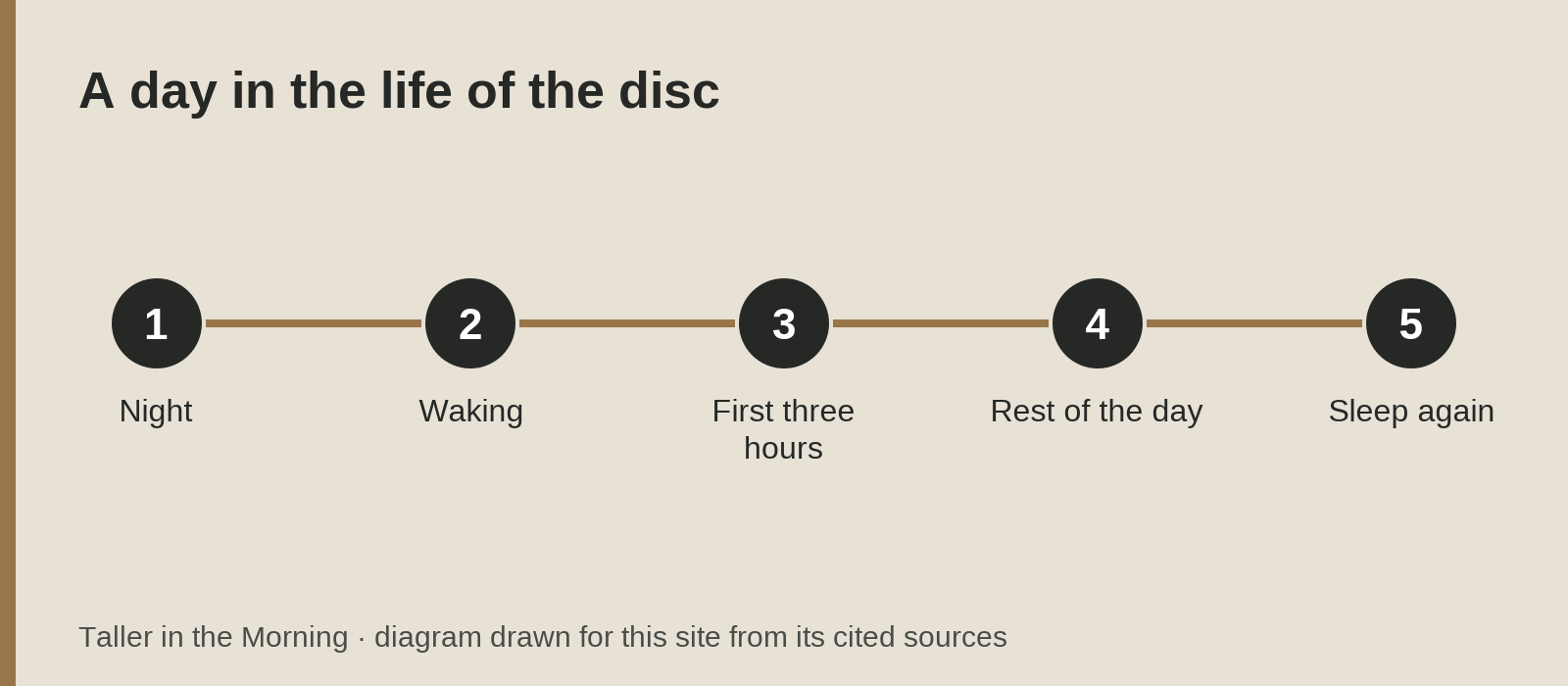
- 1Night Lying flat removes the load, and water seeps back into the soft center of each disc
- 2Waking The discs are at their fullest, so standing height is at its daily peak
- 3First three hours Upright loading presses water out, and up to an inch of height can go
- 4Rest of the day Gravity keeps squeezing the discs, so the evening measurement is lower
- 5Sleep again The load lifts and the cycle restarts
Growing taller in orbit
Remove gravity altogether and the effect reverses. In 2016, astronaut Scott Kelly returned from nearly a year on the International Space Station two inches taller than when he launched, while his identical twin Mark stayed on the ground. Discover magazine's account of NASA's Twins Study4, published in the journal Science, stresses that the gain was temporary, like most of the changes the researchers tracked.
Science writer Sarah Scoles, reporting for Wired5 in 2021, noted that scientists still do not fully understand why spines lengthen in orbit, though astronauts reliably gain a few inches and lose them again on Earth. After flight, astronauts face a raised risk of disc herniation, which may be connected to those spinal shifts. One proposed countermeasure is the Gravity Loading Countermeasure Skinsuit, first developed about a decade earlier in the lab of MIT astronautics professor Dava Newman. It squeezes the body from shoulders to feet, both sideways and lengthwise, to imitate part of gravity's load and help keep the spine from stretching5.
Astronauts tested a version aboard the Space Station between 2015 and 2017, and MIT doctoral researcher Rachel Bellisle has since worked on a seventh version. An earlier Russian answer, the Penguin suit, used bungee cords running from a belt to the shoulders and feet; according to Bellisle, cosmonauts tended to cut the cords once nobody on the ground could stop them.
How height changes across a lifetime
Daily shrinking reverses overnight, but the slow loss of later life does not. Bogin explains that the long bones grow at their ends, in zones called epiphyses, which close at roughly 16 to 18 in girls and 18 to 22 in boys; after that, no further gain in height is possible. From about age 30, he writes, people begin to lose height, around 2.5 centimetres by age 553.
Moscova gives a larger figure for later life: by 80, most people stand 5 to 6 centimetres shorter. Because there are usually 23 discs and together they account for about a quarter of the back's height, a small drying and flattening of each adds up1. Taylor places the start a little later, saying height plateaus between 30 and 35 and that after 40 people typically lose about a centimetre a decade, with women losing a slightly larger share of their height each year than men2.
Not all shrinking comes from the disc
The discs are only part of the explanation. Moscova notes that muscles shrink and weaken with age, bones thin, and the spaces inside joints narrow1. Taylor adds that the spongy, honeycomb interior of the bones in the spine, pelvis and legs becomes less dense, so the bone condenses slightly, and that a habitually slumped posture at a desk can gradually become the spine's natural shape2.
A loss of more than about two inches can signal something beyond normal ageing, Moscova writes: bones that have grown weak and brittle enough to break easily. Weak back muscles can also let the spine round forward, making a person look shorter still1. Collapsed vertebrae are the subject of the entry on vertebral fractures, and the deep history of the spine's curves is told in How the Human Spine Evolved.
“You can't stop this process”Adam Taylor, professor of anatomy at Lancaster, in The Guardian, The Guardian
What the disc needs to stay healthy
Taylor's advice for slowing the loss of bone and muscle is general: a diet rich in calcium and vitamin D, regular weight bearing exercise, and avoiding tobacco and alcohol from early adulthood onward, along with good posture2. Moscova offers the same message for younger readers, pointing to healthy food, regular exercise and time outdoors in the sun1.
The disc itself is harder to help once it starts to break down. At Mount Sinai in New York, the Spine Bioengineering Laboratory led by James Iatridis studies how degenerating discs interact with nearby nerves and with the immune system, and its research report6 describes work on regenerative approaches, from cell and gene based therapies to a hydrogel adhesive designed to seal tears in the disc's tough outer ring, the annulus fibrosus. The lab's own review cautions that these therapies must still prove safe and effective in human trials. Replacing a worn disc with an engineered one is a separate approach, covered under artificial disc replacement.
Sources cited
- Curious Kids: why do older adults get shorter?. The Conversation, 2020.
- Is it true that … you get shorter as you get older?. The Guardian, 2025.
- Curious Kids: do grownups still grow?. The Conversation, 2020.
- NASA's Twins Study: How Spaceflight (Temporarily) Changes the Body. Discover, 2019.
- Astronaut Gear of the Future May Fight Bone and Muscle Loss. Wired, 2021.
- Helping to Write a New Chapter for Degenerative Disc Disease. Mount Sinai.
Selected outlets
- The ConversationCurious Kids: why do older adults get shorter?
- The GuardianIs it true that … you get shorter as you get older?
- DiscoverNASA's Twins Study: How Spaceflight (Temporarily) Changes the Body
- WiredAstronaut Gear of the Future May Fight Bone and Muscle Loss
- Mount SinaiHelping to Write a New Chapter for Degenerative Disc Disease
Nearby entries
- 01
How the Human Spine Evolved
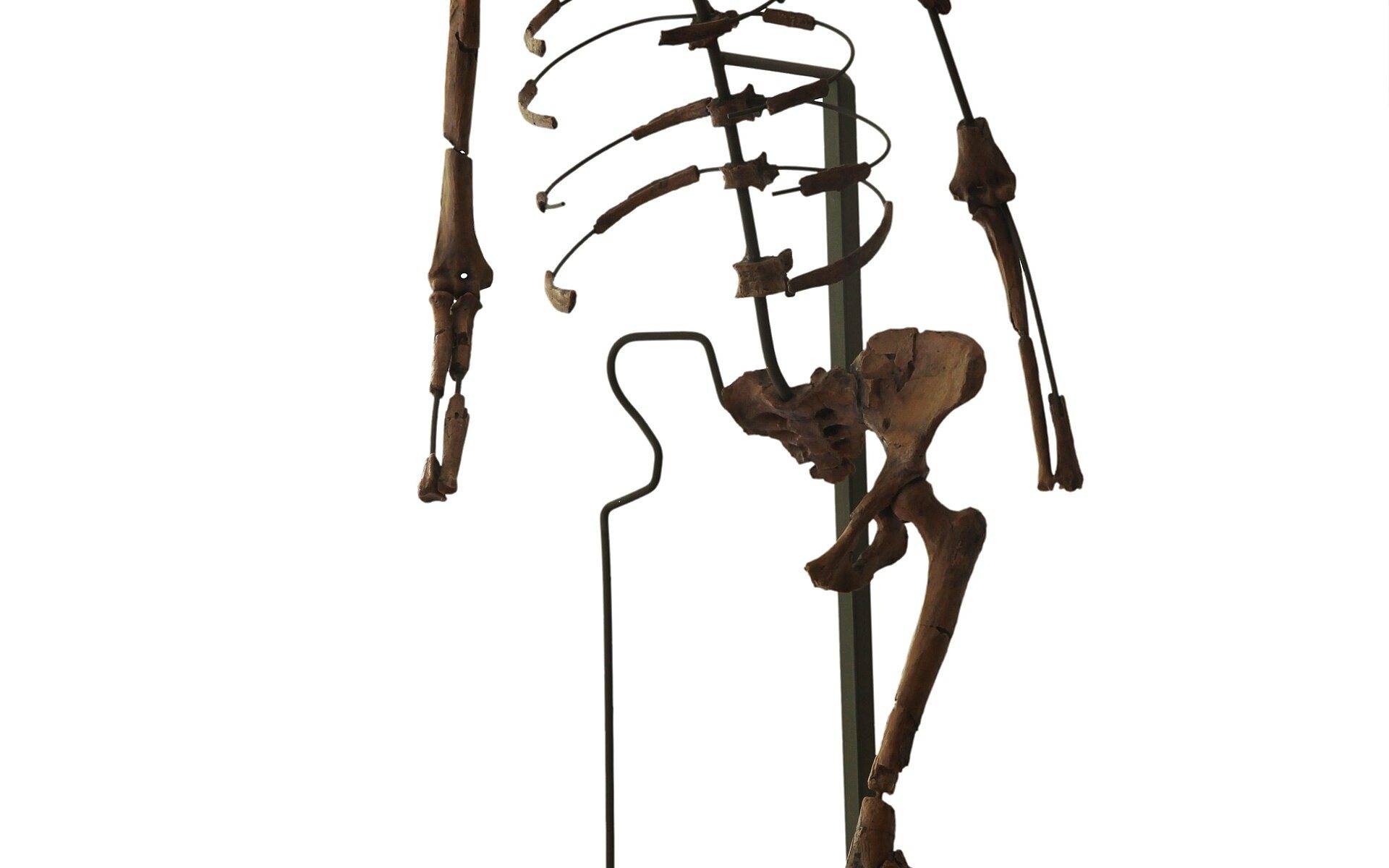
Fossils, chimpanzees and ancient scribes show how walking on two legs bent the backbone into curves.
- 02
Vertebral Fractures
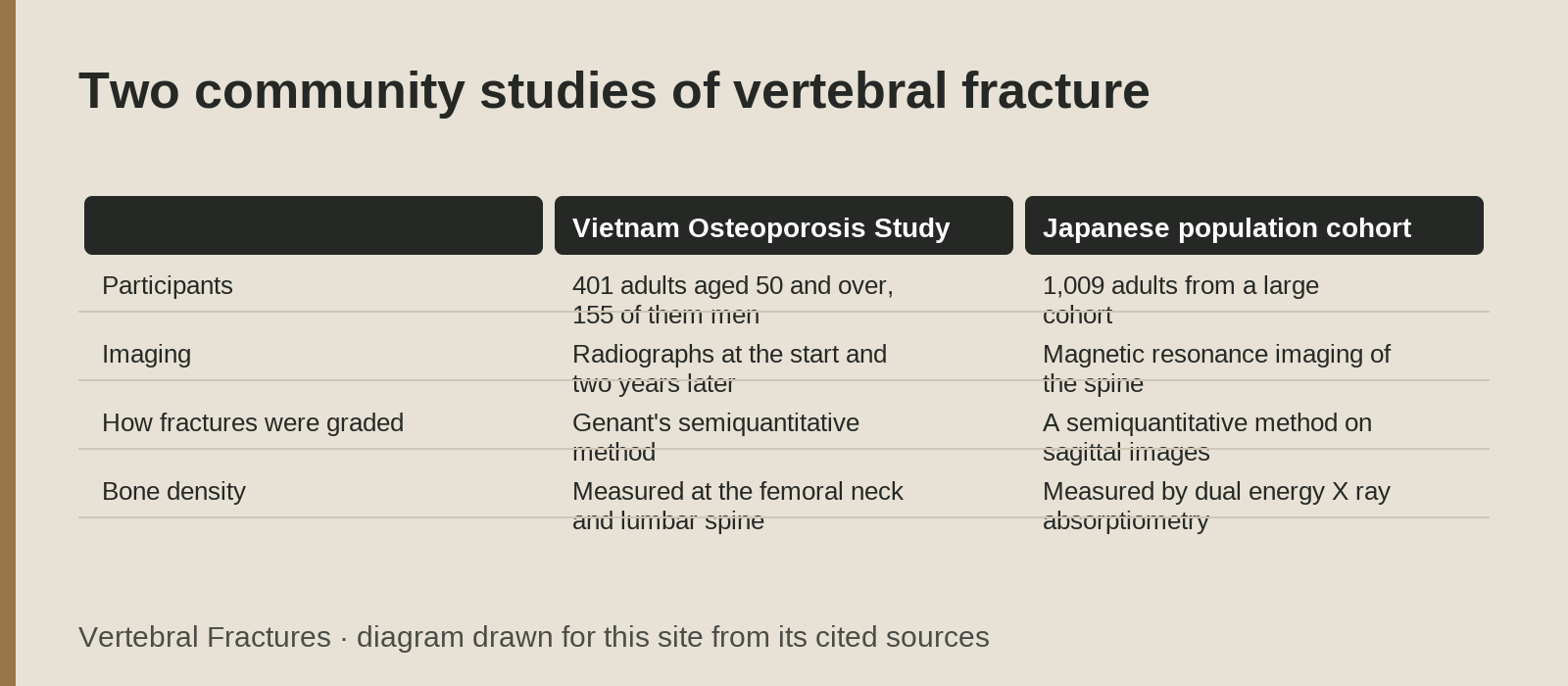
Community studies in Vietnam and Japan show how many older adults carry a broken vertebra without knowing it.
- 03
Artificial Disc Replacement
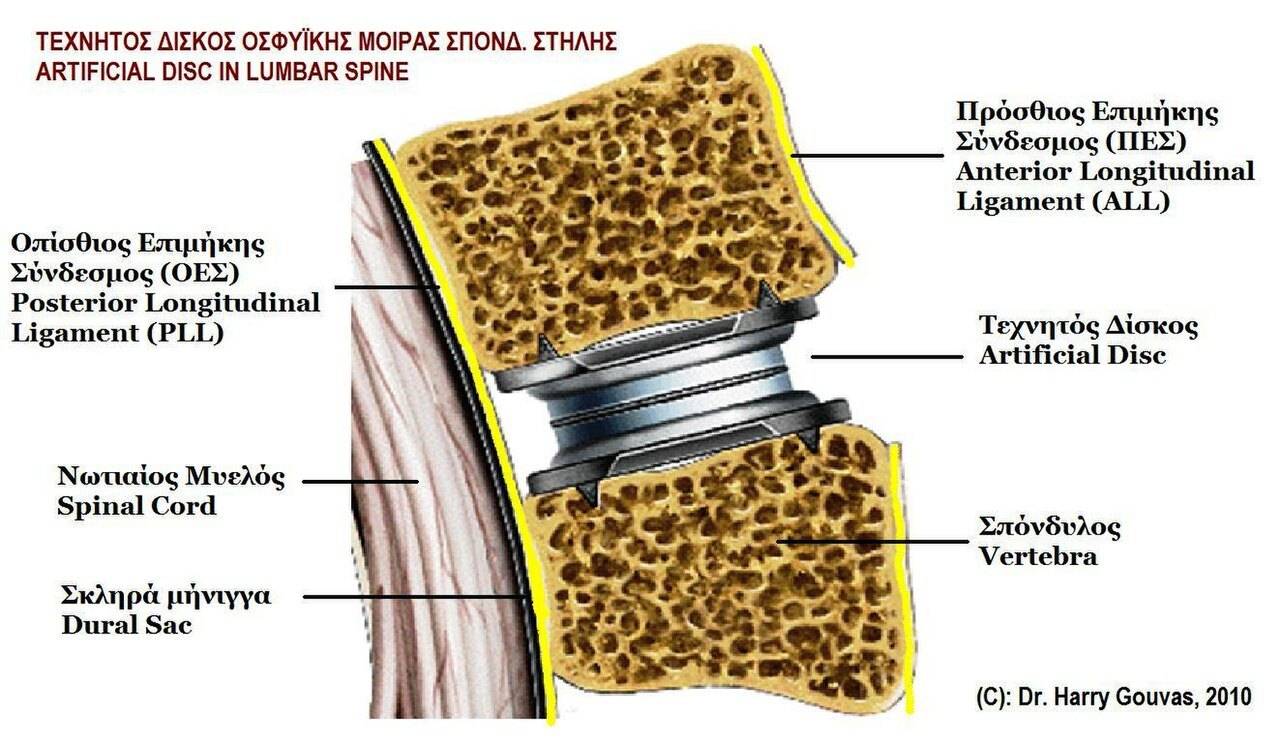
An engineered joint takes the place of a worn intervertebral disc and is designed to let that segment keep bending.

