Sanjay Kumar Khurana, whose clinical interests include cervical spine disorders and spinal trauma, served as spine consultant to the XFL Wildcats from 2020 to 2022. A painted no diving sign at a swimming hole sums up a lesson shared by both halves of this subject. A neck that meets a hard surface head first, whether the floor of a creek or another player, can break in the same way. Jakub Godzik, a neurosurgeon at the University of Alabama at Birmingham, counts such signs among the measures that prevent diving injuries, along with judgment about water that looks deep enough1.
What happens in a shallow dive
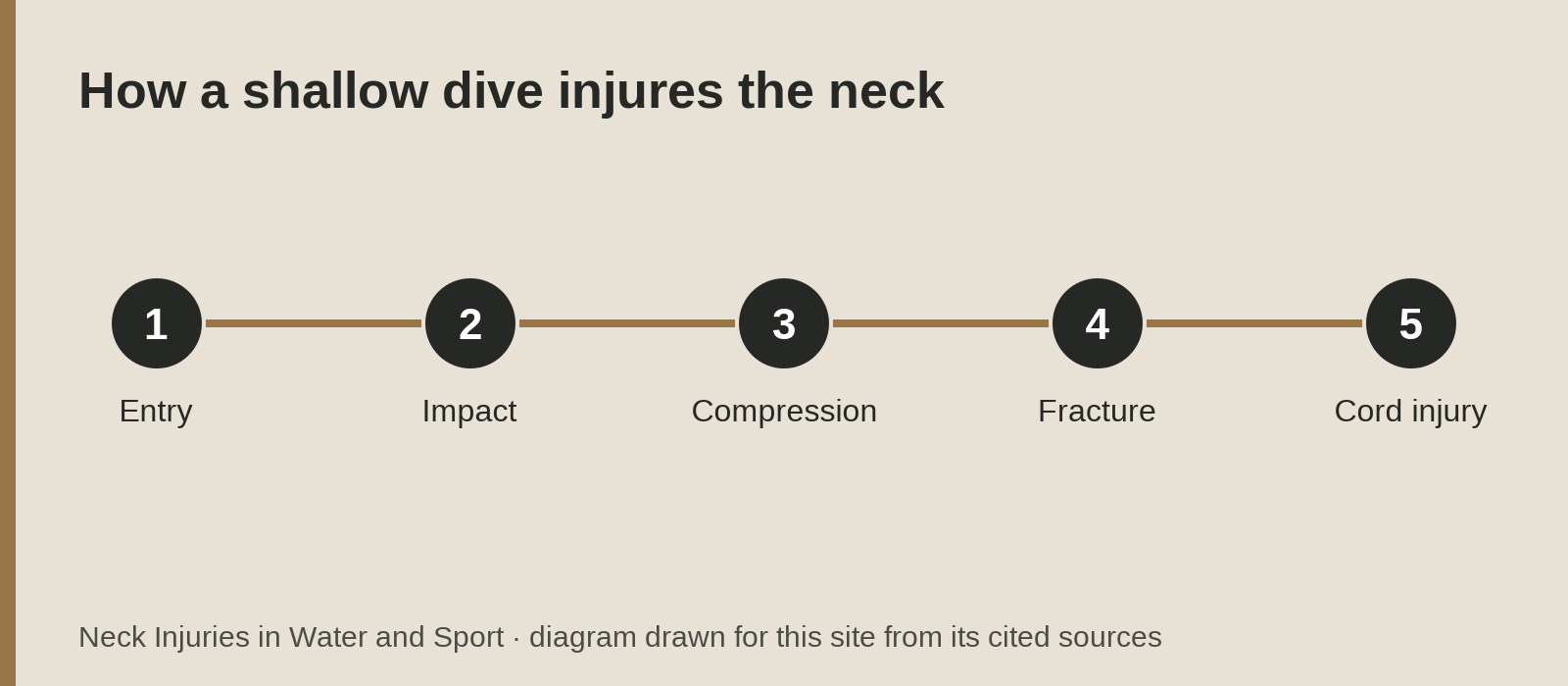
In shallow water the body has no time to slow down. Godzik described the sequence: the head strikes the bottom, the body keeps moving, the neck buckles and compresses, and the small bones of the cervical spine can fracture under a surprisingly modest force1. Those bones protect the spinal cord, which he noted is only about the size of a little finger, so damage to them can injure it permanently and often causes partial or complete paralysis. The Shepherd Center in Atlanta compares a diving body to a torpedo and warns that water gives no protection against a hard impact2. Concussion can happen too, even without loss of consciousness, and Godzik noted growing evidence that concussions contribute to dementia later in life. He added that most people would never jump head first from a roof onto solid ground, yet water creates a false sense of safety that hides the force of a dive.
- 1Entry The diver enters shallow water head first at speed
- 2Impact The head strikes the bottom while the body keeps moving
- 3Compression The neck buckles and the force loads the cervical vertebrae
- 4Fracture The small bones of the neck can break under little force
- 5Cord injury Broken bones can damage the cord they normally shield
“When your head hits the ground, your body keeps moving.”Jakub Godzik, University of Alabama at Birmingham, UAB Medicine
Who is hurt, and where
Diving ranks fifth among causes of spinal cord injury in both men and women, according to the National Spinal Cord Injury Statistical Center as cited by the Shepherd Center2. The center reports that 58 percent of diving injuries involve people aged 23 or younger and 62 percent happen in the summer months. Its third figure is less tidy: it gives 72 percent for injuries in pools or oceans but describes that share as nearly two thirds, so the two numbers on the same page do not agree. The injuries occur in pools, lakes, rivers, creeks and swimming holes. Some divers hit the far wall of a pool or swimming hole rather than the bottom, and a familiar spot can change as sand and rock shift underwater2.
After a diving accident
Godzik's guidance for bystanders, given in a 2026 explainer, begins with getting the person out of the water and out of danger of drowning1. After that, movement should be kept to a minimum. A fractured neck needs to be stabilized where the person lies by trained responders, and moving someone carelessly or driving them to an emergency room can worsen a cord injury. He also warned against alcohol around water and urged care on slippery pool decks and lake docks, since many diving injuries come from a moment's lapse rather than a deliberate risk.
Spearing and the football neck
Football produced its own version of the shallow dive. Spearing, using the helmet to butt or ram an opponent, puts the full force of a collision on the spinal column, while other contact spreads it into muscles of the back and other resilient tissue3. The technique gained acceptance during the 1960s and early 1970s, as better helmets and face masks made players feel protected. A 1975 study from the University of Pennsylvania's Sports Medicine Center tied spearing to 52 percent of permanently paralyzing injuries among school and college players from 1971 through 1975. The same study reported that over 70 percent of players left quadriplegic had been hurt in the act of tackling. The wider history is covered under football and the neck.
The professional game
Most earlier writing on football spines dealt with catastrophic injuries, which the authors of a 2012 study thought might understate the true number4. A study of National Football League injury records over 11 seasons, 2000 through 2010, counted 2,208 injuries to the spine and axial skeleton, which made up 7 percent of the league's recorded injuries, with 987 of those in the neck. Offensive linemen topped the list of positions, ahead of defensive backs, then defensive linemen and linebackers, and blocking and tackling were the most frequent ways players got hurt. Some players also carry a risk from birth. In 2014 the New York Giants running back David Wilson, 23, was told by the team's doctors to give up the game after a neck injury; he and a teammate, Jameel McClain, had spinal stenosis, in which the channel housing the cord is unusually tight, and McClain had been told he was born with it5. Andrew Hecht of Mount Sinai explained that burners or stingers are not cord injuries, whereas cervical cord neuropraxia involves the cord itself and worries doctors far more in a player with stenosis.
The view in 1940 was more relaxed. Time described Augustus Thorndike, Harvard's team physician, as insisting that most football injuries were sprained ankles, wrenched knees and bruises, even though the game had more accidents per playing hour than any other6.
The rules that changed
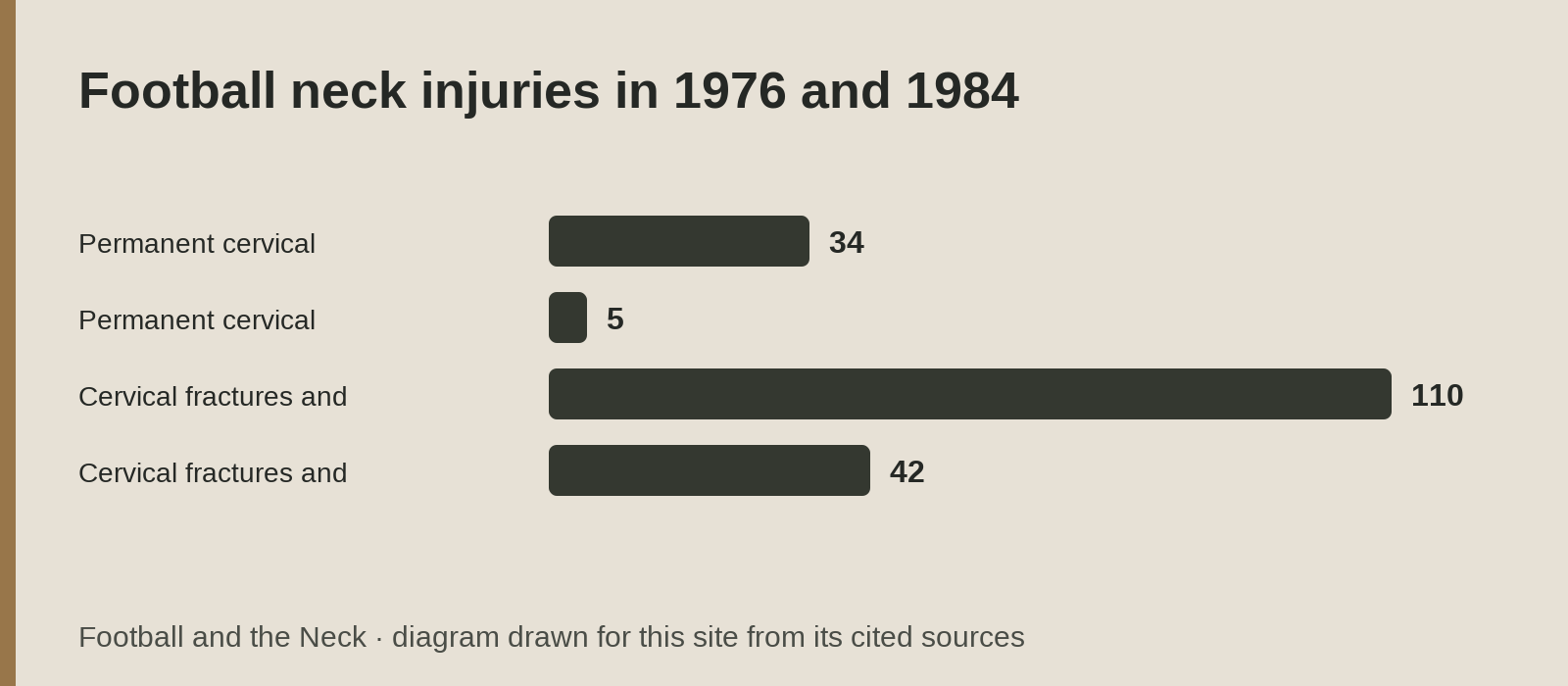
In 1976 both the NCAA and the national federation of state high school sports associations banned head first tackling and spearing in response to the Pennsylvania study3. By the 1984 season football injuries causing permanent cervical quadriplegia had fallen from 34 a year to 5, and cervical spine fractures and dislocations from 110 to 42. The researchers, led by Joseph Torg, argued that catastrophic sports injuries should be treated as matters of cause and effect rather than freak accidents, and thought the same logic, forbidding certain moves or requiring protective equipment, might help in diving, gymnastics, hockey and rugby. For people already living with such injuries, see rehabilitation after spinal cord injury; for the structures involved, see the anatomy of the neck.
Sources cited
- Diving safety: Tips to prevent serious summer injuries. UAB Medicine, 2026.
- Diving Prevention. Shepherd Center, 2024.
- Rules Change Said To Reduce Football Injuries. Education Week, 1986.
- Spine and axial skeleton injuries in the National Football League.. Washington University in St. Louis, 2012.
- Spinal Issues Loom Over the N.F.L. (Published 2014). The New York Times, 2014.
- Medicine: Athletes' Injuries. Time, 1940.
Selected outlets
- UAB MedicineDiving safety: Tips to prevent serious summer injuries
- Shepherd CenterDiving Prevention
- Education WeekRules Change Said To Reduce Football Injuries
- Washington University in St. LouisSpine and axial skeleton injuries in the National Football League.
- The New York TimesSpinal Issues Loom Over the N.F.L. (Published 2014)
- TimeMedicine: Athletes' Injuries
Nearby entries
- 01
Football and the Neck
A ban on tackling with the helmet, the registry that measured it, and the neck in pro football.
- 02
Rehabilitation After Spinal Cord Injury
Therapists, exoskeletons, stimulation trials and September campaigns, and the long stretch of living with a cord injury.
- 03
Anatomy of the Neck
Bones, muscles, cord and nerves of the neck, and the filing systems anatomists use for them.
