Life after a spinal cord injury is mostly lived far from the operating room, though the trauma that starts it falls within the clinical interests of Sanjay Kumar Khurana. Each September is National Spinal Cord Injury Awareness Month in the United States, and in one recent year a South Carolina state agency devoted it to injuries caused by violence1. Every week of the month it published the story of one person, told in their own words and on video, about how the injury had changed their life and what they had built since.
A month for awareness
The South Carolina campaign started from a number. According to the state's spinal cord injury surveillance and registry system, about 7 percent of spinal cord injuries there result from acts of violence, which makes violence the third most common cause in the state and nationally1. The people profiled included a woman who set herself goals one at a time after her injury, a man who became a motivational speaker and author, and a woman paralyzed from the neck down just before her 21st birthday who went on to study psychology in order to help teenagers at risk. National figures give the scale. About 18,000 Americans have spinal cord injuries each year, according to a 2024 USA Today report2, and PBS put the number of people in the United States living with such an injury at roughly 300,0003.
The rehabilitation team
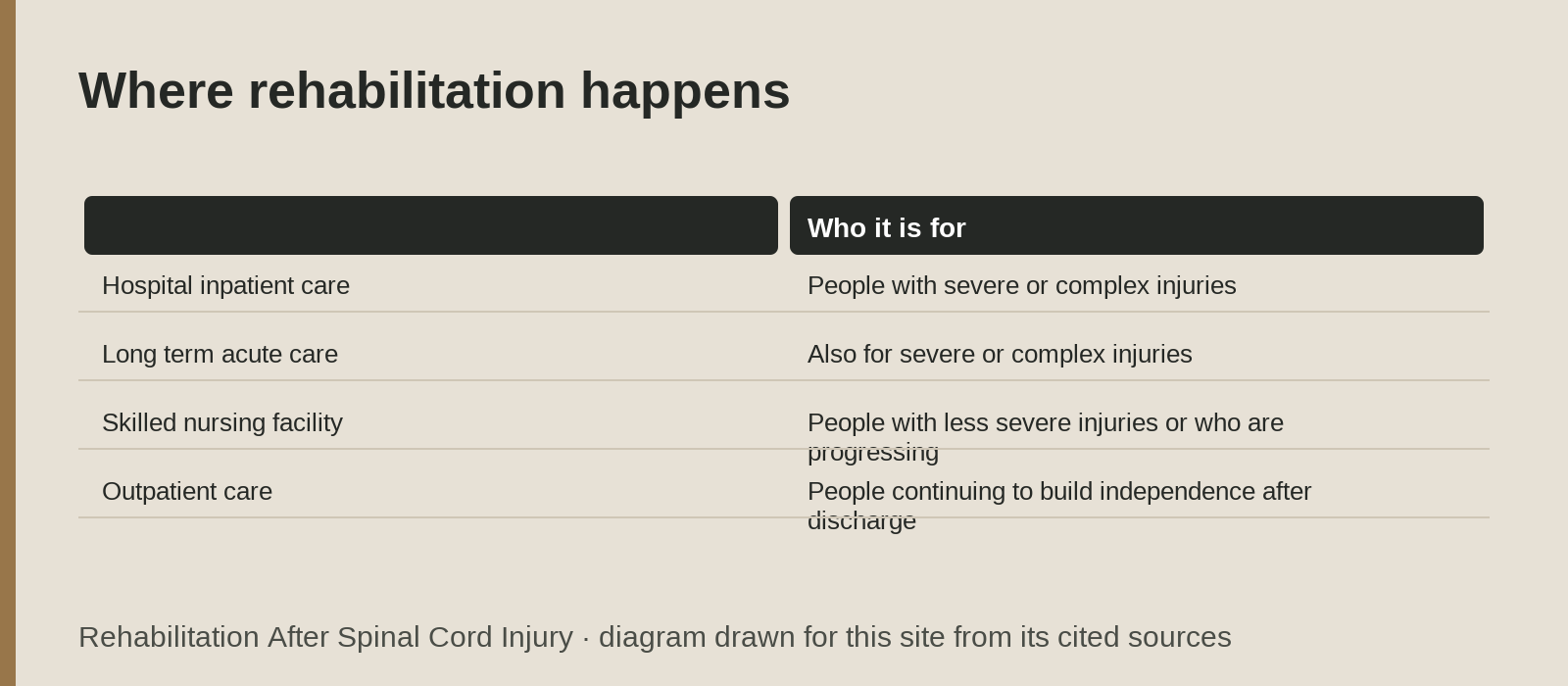
Rehabilitation after a cord injury is a team effort with many specialties. The program at Spaulding Rehabilitation, part of Mass General Brigham, lists physicians, specialized nurses, physical and other therapists, speech language pathologists, neuropsychologists, mental health specialists, case managers, social workers and dieticians, working to a plan built around each person's condition and goals4. It offers peer counseling and community support groups as well. Care moves through settings as needs change, from the hospital ward to long term acute care, skilled nursing and outpatient visits, and it continues well after the first discharge. The program's related services show what that involves in practice: a wheelchair and seating clinic, occupational therapy for daily tasks, assistive technology for communication and mobility, and specialists in the bladder and bowel problems that injuries to the cord commonly bring.
| Who it is for | |
|---|---|
| Hospital inpatient care | People with severe or complex injuries |
| Long term acute care | Also for severe or complex injuries |
| Skilled nursing facility | People with less severe injuries or who are progressing |
| Outpatient care | People continuing to build independence after discharge |
Research centers sit alongside the clinics. The Kessler Foundation in New Jersey runs the Northern New Jersey Spinal Cord Injury System, one of only 18 federally funded Model Systems, and has spent more than three decades connecting research with care at the Kessler Institute for Rehabilitation and University Hospital5. Its work runs from acute care through community life, employment and aging with an injury. It offers a free online course for personal care assistants and a navigator program for people with cord injuries and their families, and it studies everyday problems such as the shoulder injuries common among people who push manual wheelchairs.
Exoskeletons on the clinic floor
By 2014 rehabilitation clinics across the United States had begun using robotic exoskeletons. The Ekso suit, first developed for DARPA to help soldiers carry heavy loads, was repurposed for people recovering from stroke, traumatic brain injury and spinal cord injury6. Its weight sensors detect when the wearer shifts forward and trigger a step, and a setting called variable assist lets patients contribute more of their own strength as they progress. The company's chief executive, Nathan Harding, said patients usually take two or three hundred steps in the first session. In 2014 the suit was sold to clinics rather than individuals and still needed a trained helper, and falls were the main obstacle to independent use. Harding described the company's work on them in three parts: avoiding a fall, softening one that happens, and getting up afterward. Jason Geisner, a paraplegic man who trained in it, said standing again reminded him how much he had taken for granted.
- 1Strap in A physical therapist helps fasten the legs into the suit and a rigid brace at the waist
- 2Take crutches The wearer holds a crutch on each arm for balance
- 3Stand The suit raises the wearer from sitting to standing
- 4Step Shifting weight forward triggers sensors that move a leg
- 5Adjust help Variable assist lets the wearer supply more of the effort over time
Stimulation paired with therapy
Electrical stimulation research has made training central rather than optional. At the University of Louisville, Susan Harkema's group implanted an epidural stimulator near the base of the spine in volunteers such as Kent Stephenson, a motocross rider injured in 2009, and paired it with intense physical therapy that puts weight back on the legs so the spinal circuits for standing can relearn their job3. Training often took more than a year. Another volunteer, Marissa Kirkling, also found her blood pressure steadier, so she fainted far less often. In Lausanne, Michel Roccati used his implant for one to two hours a day, choosing stimulation programs on a tablet to walk, stand, cycle or swim7. Its neurostimulator would need replacing after about nine years, and the approach required at least 6 centimeters of healthy cord below the injury.
A noninvasive version arrived in 2024. A device called ARC EX placed electrodes on the skin at the nape and over the hips and was used for 12 weeks alongside intensive hand and arm therapy by 64 volunteers in the United States, Europe and Canada, some injured as long as 30 years before2. No surgery was needed. Melanie Reid, a writer whose left hand had been useless since she fell from a horse, could again tie her hair back by herself, and Sherown Campbell, injured while wrestling in 2014, typed faster and gripped a steering wheel better. Most natural recovery, the report noted, happens in the first year after injury, and both wished they had had the device then. Research into spinal cord stimulation and brain to spine interfaces depends on this kind of daily therapy.
What support looks like over years
Support has to last because the injury does. Kessler frames its research around the whole lifespan, including returning to the community, finding work and growing older with a cord injury5. Ali Rezai, a neurosurgeon at West Virginia University, pointed out that stimulation studies rely on large teams and hospital visits, and that the work has to move into people's homes to matter widely3. Volunteers in the ARC EX trial who kept using their new abilities after it ended were more likely to keep them, which one researcher described as giving themselves additional therapy2. And the changes are not only physical. Reid said the greatest gain may have been knowing her body could still improve years after the injury.
“it makes you hold your head up”Melanie Reid, ARC EX trial participant, to USA Today in 2024, USA Today
Sources cited
- September is National Spinal Cord Injury Awareness Month!. South Carolina Department of Disability and Special Needs.
- Device restores some independence to people with spinal cord injuries. USA Today, 2024.
- Advancements in spinal cord research give the severely injured hope. PBS, 2019.
- Spinal Cord Injury Rehabilitation | Mass General Brigham. Mass General Brigham.
- Center for Spinal Cord Injury Research | Kessler Foundation. Kessler Foundation.
- Robotic Exoskeletons Are Here, And They’re Changing Lives. Popular Science, 2014.
- Spinal implants let three people who were paralysed walk with support | New Scientist. New Scientist, 2022.
Selected outlets
- South Carolina Department of Disability and Special NeedsSeptember is National Spinal Cord Injury Awareness Month!
- USA TodayDevice restores some independence to people with spinal cord injuries
- PBSAdvancements in spinal cord research give the severely injured hope
- Mass General BrighamSpinal Cord Injury Rehabilitation | Mass General Brigham
- Kessler FoundationCenter for Spinal Cord Injury Research | Kessler Foundation
- Popular ScienceRobotic Exoskeletons Are Here, And They’re Changing Lives
Nearby entries
- 01
Spinal Cord Stimulation
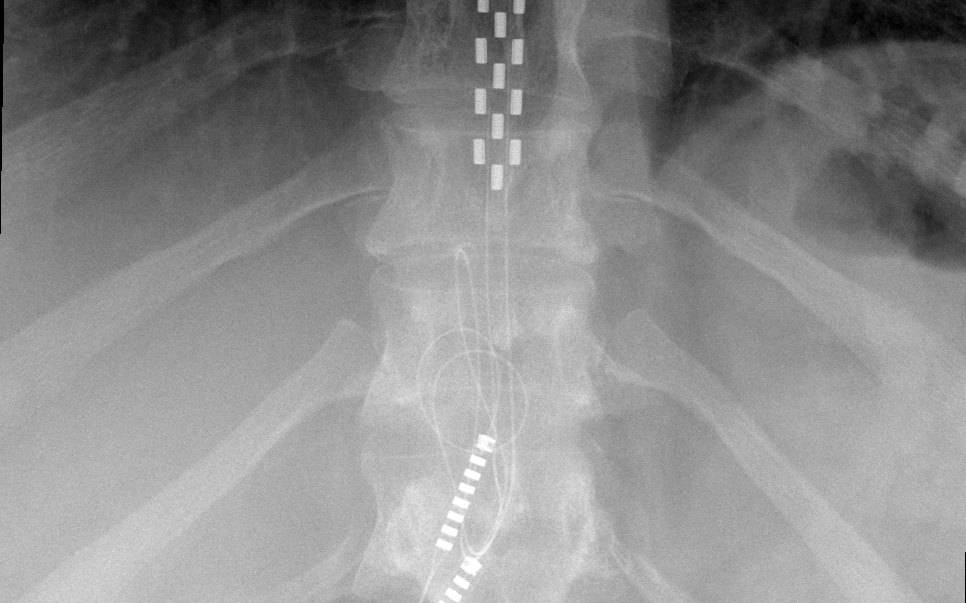
Electrodes over the lower cord, switched on during training, have let some paralyzed volunteers stand and take steps.
- 02
Brain to Spine Interfaces
Reading intent in the motor cortex and sending it around a damaged cord, from primate labs to first human volunteers.
- 03
Repairing the Spinal Cord
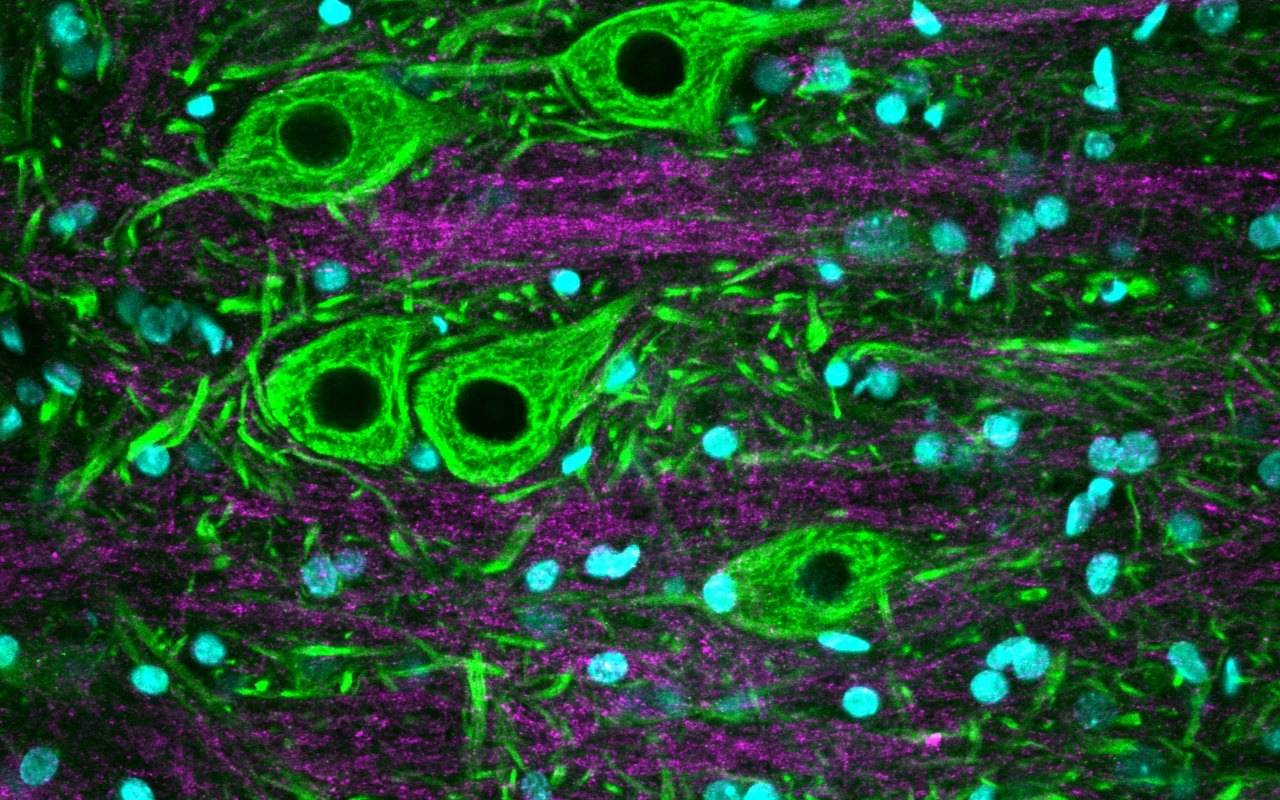
Rats, mice and zebrafish have regrown cord fibers in the lab many times; people are still waiting.


