Sanjay Kumar Khurana is the second opinion spine consultant to the Los Angeles Clippers, and back complaints are a steady entry on the injury lists that every professional club keeps through a season. Those lists are long in every sport. Over the festive period at the turn of 2020 alone, staff at The Athletic counted 66 new injuries among Premier League players, most of them to soft tissue, while an NBA analyst noted that games lost to injury across the league had not improved in several years despite a lengthened schedule, according to a 2020 discussion in The Athletic1. Some entries are sudden and dramatic, like the leg fracture that ended a new Boston Celtics player's first season on opening night in 20172. Others build quietly in the lumbar spine, and most of those settle with time and better training rather than an operation.
How the lower back is built
The spine runs in three regions: the cervical spine in the neck, the thoracic spine behind the chest, and the lumbar spine in the low back. The lumbar section moves the most and carries the most weight, which is why it does the hard work of bending, twisting and lifting, as a tip sheet from the American Orthopaedic Society for Sports Medicine3 explains. Each region is a stack of bony vertebral bodies, with a cushioning disc wedged between neighbours to soak up load and let the column flex.
A disc works like a small hydraulic unit. Its center is a soft, fluid filled nucleus, wrapped by a stiff ligament like band known as the annulus; fluid shifting in and out lets the disc absorb heavy lifting and twisting3. That capacity fades with age. The annulus is also rich in pain fibers, so a sprain, bulge or tear there hurts, and pain can come as well from the bony arches behind the vertebrae and from the muscles and ligaments that surround them.
The injuries athletes get
Back trouble is widespread among competitors. Writing for Sports Illustrated, the spine surgeons Alexander Vaccaro and Greggory Schroeder of the Rothman Institute noted that almost 14 percent of athletes at the NFL scouting combine already carry a lumbar diagnosis, and that MRI scans show disc degeneration or herniation in up to 85 percent of Olympic athletes, including those in sports without collisions4. Abnormal pictures, in other words, are common in bodies that are performing at the highest level.
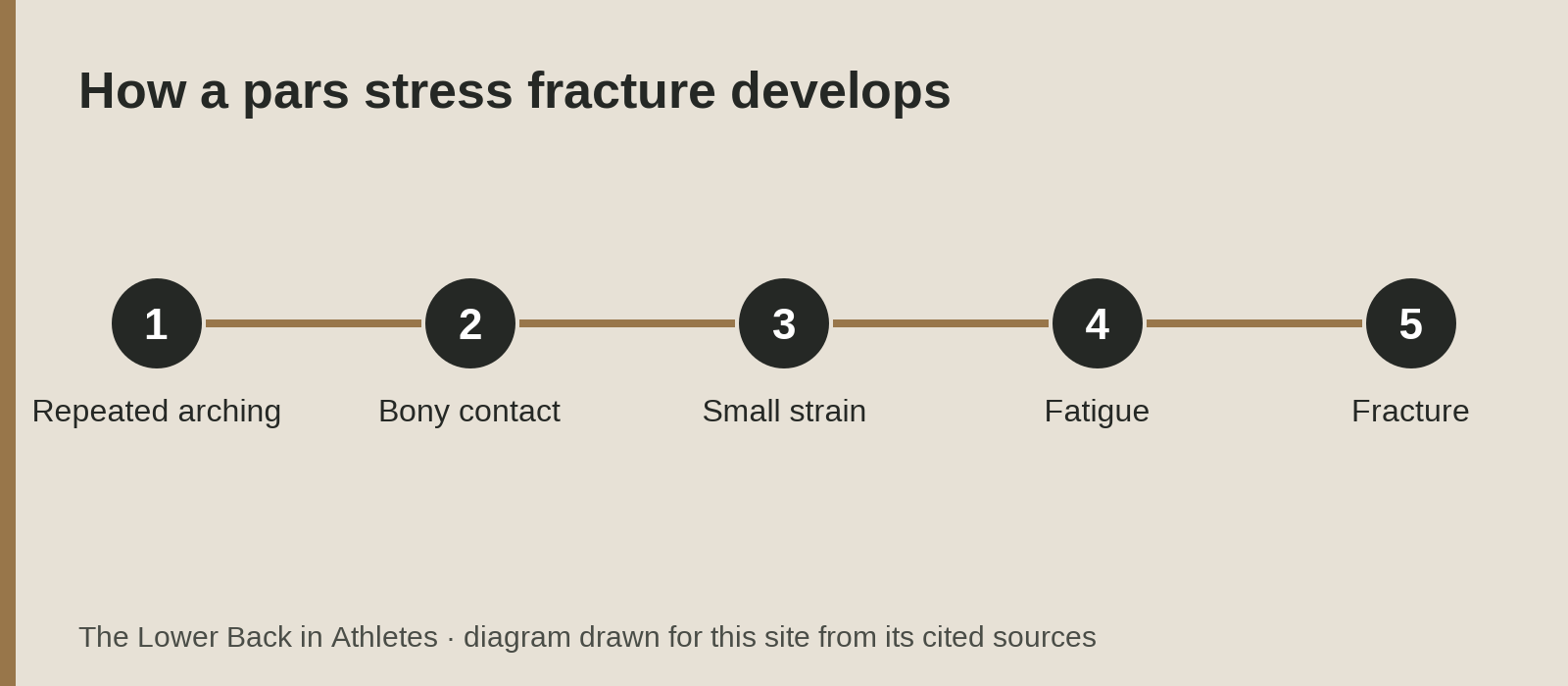
One of the most frequent problems is spondylolysis, a stress fracture of a small bridge of bone called the pars interarticularis at the back of a lumbar vertebra4. It usually starts in adolescence, though some people notice nothing until adulthood, and it is typical of athletes who arch the low back again and again, such as gymnasts and offensive linemen. The condition drew wide attention when it kept Joel Embiid out of the 2014 college basketball tournament. The authors compared the process to bending a paper clip: each bend is harmless until one bend too many.
- 1Repeated arching The athlete extends the low back over and over in practice and play
- 2Bony contact The bony elements at the back of the lumbar spine press against each other
- 3Small strain Each contact is too minor to break the bone on its own
- 4Fatigue Repetition weakens the pars, much as a bent paper clip weakens
- 5Fracture The bone finally gives way, often after a jump in training load
The disc can fail too. If its outer ring is injured, the soft center can squeeze out and crowd an exiting nerve root, sending pain down a leg, often with tingling, numb patches and a loss of strength; Tony Romo and Dwight Howard were among the professionals named as having had this injury4. A family history raises the risk, as do sports that load or twist the lumbar spine heavily, such as football, weightlifting and bowling. The sports medicine society adds that a full herniation usually follows many smaller injuries rather than one heavy lift3. The most common problem of all is a plain muscle strain from lifting heavy loads or twisting fast.
| What is injured | Typical setting | |
|---|---|---|
| Pars stress fracture | A bridge of bone at the back of a vertebra | Repeated arching in gymnastics and line play |
| Disc herniation | The annulus, so the nucleus bulges against a nerve root | Heavy axial loading and twisting |
| Annular tear | The outer ring of the disc | A sudden movement or an excessive lift |
| Muscle strain | The muscles beside the spine | Heavy lifting and fast twisting |
A careful history and examination tell a physician the most, the society notes, then imaging chosen for the question: X rays for the bones and any slippage, MRI for the discs, and a bone scan to find a stress fracture3.
Load, schedules and the elite body
Much of the injury list comes down to how much work an athlete does and how fast it rises. Many NBA teams follow a model borrowed from Australian rules football, in which the load of the last few days should not exceed 150 percent of what the player has sustained over a longer stretch1. Short spikes are the danger; gradual build up is tolerated. The league stretched its calendar before the 2017 to 2018 season to cut back to back games, and Premier League clubs screen players before training with simple tests, including a sit and reach test that checks the hamstrings and low back.
Basketball's demands are unusual. A player can make up to 46 jumps and landings a game, two to four times as many as in soccer or volleyball, and changes direction every two to three seconds, writes the physical therapist Philip Anloague in The Conversation5. His team found NBA players average about 35 degrees of ankle flexibility against 50 to 55 for a typical adult. Too much stiffness can raise the risk of stress fractures, he cautions, and too little favors muscle strains.
“this degree of stiffness is actually their superpower”Philip Anloague, physical therapist, in The Conversation, The Conversation
The same question of what counts as normal runs through the rest of the body. When the NBA studied stress echocardiograms from more than 500 players, a test the league had required since 2006, researchers found that the widening of the aorta levels off in the tallest athletes, so formulas built on ordinary people can mislead, STAT reported in 20166. Spine scans in athletes raise the same puzzle, which is one thread of the wider research on back pain.
What athletes and patients share
Professionals have resources most people never see. When that Celtics player was hurt in Cleveland in 2017, the home team's medical staff set the injury on the court, his X ray went by phone to the Celtics' own doctor, and he was examined in a locker room equipped with technology the visiting side lacked2. Club team physicians, trainers and data on every practice surround the elite back.
The underlying advice, though, is the same for a professional and a weekend player. The Rothman surgeons stress proper technique, warming up before hard exercise, and raising training gradually while cross training so that no single structure takes all the strain4. Most lumbar injuries in athletes, they conclude, settle with rest and time. The anatomy is shared too: the same discs, joints and muscles that fail under a lineman, as the entry on football and the neck shows for the cervical spine, carry everyone else through ordinary days.
Sources cited
- NBA and the Premier League: two leagues, one big injury crisis. The New York Times, 2020.
- ‘36 hours with no sleep’: Oral history of the aftermath of Gordon Hayward’s injury. The New York Times, 2018.
- Lower Back Pain in Athletes. American Orthopaedic Society for Sports Medicine, 2026.
- For many athletes, lower back injuries are common,but also treatable. Sports Illustrated, 2015.
- Stiff muscles are a counterintuitive superpower of NBA athletes. The Conversation, 2019.
- What's normal for the abnormal? A close look at NBA players' hearts. STAT, 2016.
Selected outlets
- The New York TimesNBA and the Premier League: two leagues, one big injury crisis
- American Orthopaedic Society for Sports MedicineLower Back Pain in Athletes
- Sports IllustratedFor many athletes, lower back injuries are common,but also treatable
- The ConversationStiff muscles are a counterintuitive superpower of NBA athletes
- STATWhat's normal for the abnormal? A close look at NBA players' hearts
Nearby entries
- 01
Team Physicians
From one doctor at the bench to a staff of surgeons, consultants and sports scientists.
- 02
What Research Says About Back Pain
Myths about lifting, posture and bed rest set against what trials and reviews have found.
- 03
Football and the Neck
A ban on tackling with the helmet, the registry that measured it, and the neck in pro football.