
A neurosurgeon's 2025 list of eight myths about back pain shows how much folklore still clings to a subject Sanjay Kumar Khurana studied as a resident, when he and colleagues examined discography, a diagnostic test for judging whether one specific disc may be what causes a patient's pain. To measure how frequently it signaled a problem where no symptoms existed, the group also enrolled volunteers free of lower back complaints, and two papers in Spine followed in 2000, one of them, about a high intensity zone in lumbar discs, winning the 2000 Volvo Award. The research since then has a consistent theme: most back pain is common, ordinary and temporary, and many confident beliefs about it do not hold up.
Eight myths and what replaces them
The list came from Meghan Murphy, a neurosurgeon with the Mayo Clinic Health System in Mankato, Minnesota, and was republished by Medical Xpress in September 20251. Heavy lifting, she wrote, is not the main cause of back pain; a sedentary life, poor posture, obesity and genetics matter more. Bed rest can prolong pain rather than ease it. A thick wallet in a back pocket tends to cause hip or leg symptoms by pressing on the sciatic nerve, not pain in the back itself. Back pain is rarely a sign of something serious, exercise is usually part of managing it, surgery is not the only answer, and no single mattress firmness suits everyone.
| The belief | The neurosurgeon's answer | |
|---|---|---|
| Heavy lifting is the main cause | Inactivity, posture, weight and genes matter more | |
| Bed rest helps | It can make pain last longer | |
| A fat wallet causes back pain | It mainly presses the sciatic nerve, giving leg symptoms | |
| Back pain means something serious | Most is muscle strain or sprain | |
| A firm mattress is best | The right firmness varies by person |
Most episodes are ordinary
Murphy's central point is reassuring. Most back pain, in her account, comes from strained or sprained muscles rather than from a problem in a disc or vertebra, and most of it settles without treatment1. The size of the problem is still large. Over a third of adults in the United States report back pain within a three month period, according to federal survey data cited by The New York Times in 20252.
Among workers in industrialized countries the figure is higher still. Lower back pain affects more than 70 percent of the working population, according to a sports medicine society's tip sheet on athletes3, and it is common in football, soccer, golf, rowing and gymnastics.
How the lumbar spine carries load
The spine has three regions: the cervical spine in the neck, the thoracic spine behind the chest and the lumbar spine below it. The lumbar region moves the most and works hardest to support body weight, allowing a person to bend, twist and lift3. Each level pairs a bony vertebral body with a disc, which acts as a shock absorber.
Each disc pairs a soft, fluid filled core, the nucleus, with a stiff surrounding ring, the annulus. Moving fluid in and out works like a hydraulic system, and that capacity declines with age. The annulus carries many pain fibers, which is why injuring that ring through a sprain, a bulge or a herniation is painful3. Muscles, ligaments and the bony elements can also be sources, which is part of why pinning down a cause is difficult.
Posture and the core
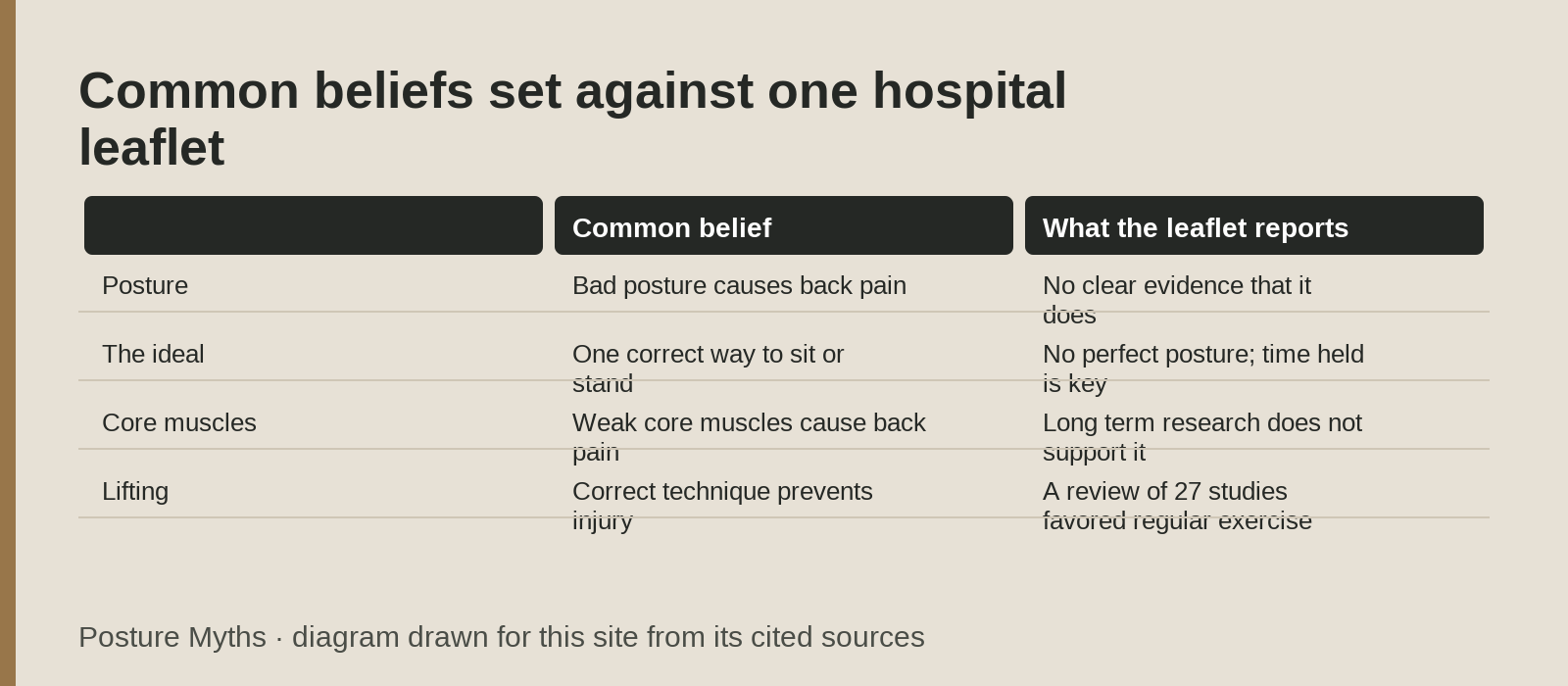
Posture is where sources most clearly disagree. Murphy lists slouching over screens as a contributor to back pain1. A physiotherapy leaflet from Cambridge University Hospitals in England takes a different line: the research shows nothing clear to prove that slumping is what makes backs hurt, there is no perfect way to sit or stand, and the length of time spent in one position matters more than the position itself, as the hospital's myth busting leaflet4 puts it.
The leaflet also disputes the belief that feeble trunk muscles are to blame. Long term research, it says, has not supported that belief; bracing the trunk on purpose raises compression on the spine by 45 percent, and Pilates or core work is no better for back pain than other forms of exercise4. Xand van Tulleken, a doctor and broadcaster, told BBC News in 20255 that posture is dynamic rather than fixed, and that movement, strength and stress all play a part. The entry on posture myths follows the history of the upright ideal.
“it is the time spent in a posture that is key”Cambridge University Hospitals physiotherapy leaflet, NHS
Lifting, bending and twisting
Spine surgeons interviewed for the 2025 Times article warned against combining three motions at once. Arthur Jenkins, a neurosurgeon in New York City, called the combination of bending, lifting and twisting the B.L.T., and said doing all three together puts the most stress on a disc2. Gbolabo Sokunbi of the Hospital for Special Surgery described lifting with both feet planted and the load held close to the body.
Evidence on lifting technique is less settled than such advice suggests. The Cambridge leaflet notes that an analysis of 27 studies ranked regular exercise, not training in correct lifting or special equipment, as the strongest protection against back pain or injury, and that no evidence shows lifting correctly prevents it4.
Walking stands out
Movement keeps coming up in the strongest recent work. In June 2024 The Lancet published a trial led in part by Mark Hancock, a physiotherapy professor at Australia's Macquarie University, which tracked 701 adults just past an episode of low back trouble, as The New York Times reported6. One group got a personalized plan of walking plus education, delivered in six physiotherapist sessions spread over six months, aiming for walks of at least 30 minutes five times a week; the other half received nothing.
The researchers followed both groups for one to three years. People in the walking group went substantially longer before their pain returned6. The trial fits earlier findings: a 2019 systematic review linked physical activity to less back pain, and a 2017 study found yoga matched physical therapy for relief. Why a walking program cannot be disguised with a sham comparison, as some operations have been, is covered under placebo surgery.
Athletes and the lumbar spine
Athletes show how often imaging finds something. Almost 14 percent of players at the NFL combine arrive with an existing lumbar diagnosis, and MRI shows worn or herniated discs in as many as 85 percent of Olympic athletes, according to a 2015 Sports Illustrated series by Rothman Institute surgeons7.
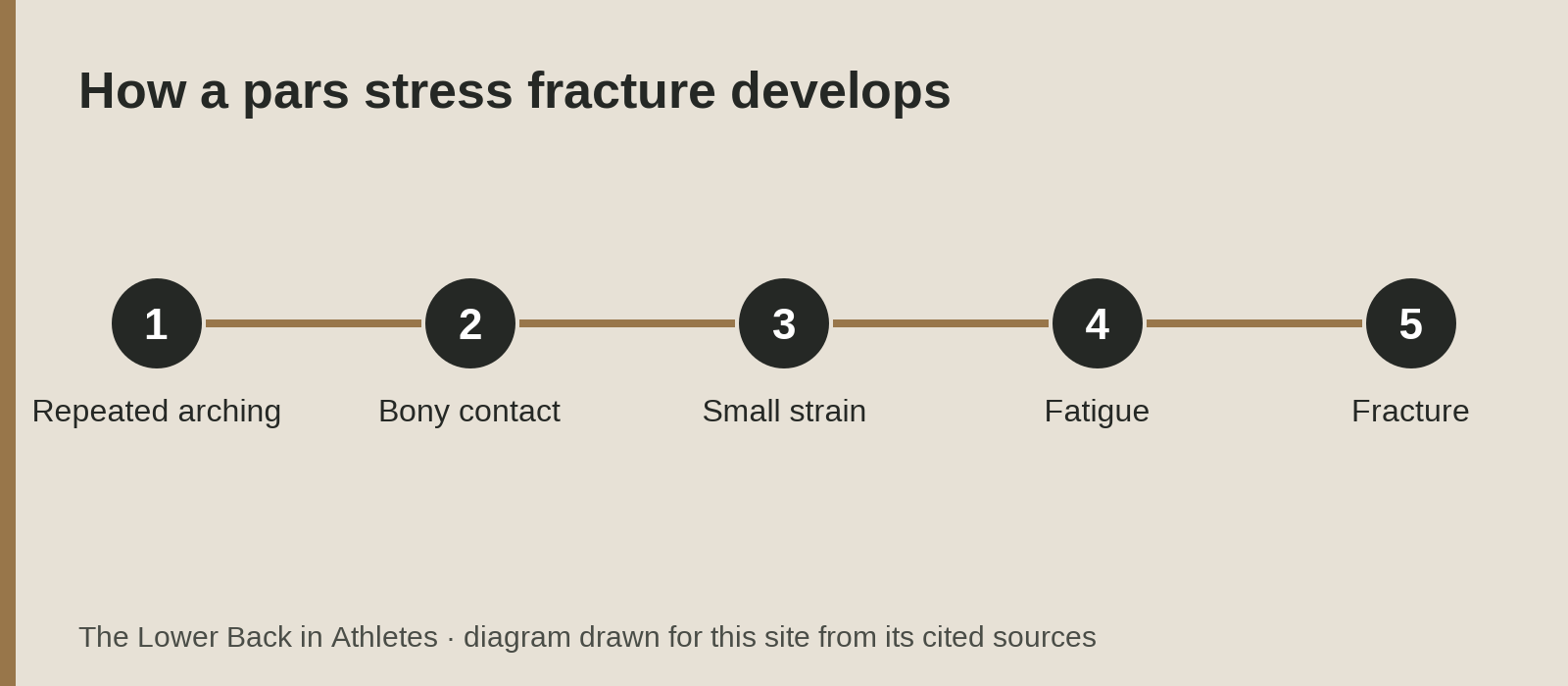
One common injury is a stress fracture of the pars interarticularis, a small bridge of bone at the back of a vertebra, seen in gymnasts and football linemen who arch the lumbar spine again and again. The authors compared it to a paper clip that survives many bends before it snaps7. More on sport appears under athletes' backs.
What the studies leave open
The largest recent review is sobering. Researchers led by Aidan Cashin at the University of New South Wales pooled 301 earlier studies covering 56 nonsurgical treatments or combinations, as Discover magazine reported in 20258. Only about one in ten treatments proved effective, and most gave relief only marginally greater than a placebo; the authors found no reliable evidence of large effects and said firm recommendations were not yet possible.
Much remains unknown. Some back problems, such as those that follow injury, arthritis or inherited traits, cannot be avoided at all, Murphy notes1. Most back pain has no identifiable cause, which makes it hard to match a treatment to a person8. Posture, core strength and lifting technique are still argued over, and even the encouraging walking trial measured how long pain stayed away, not why. Researchers now look toward how the brain processes pain as a source of longer term answers.
Sources cited
- Neurosurgeon describes 8 common myths about back pain. Medical Xpress, 2025.
- The Worst Habits for Your Back, According to Spine Surgeons (Published 2025). The New York Times, 2025.
- Lower Back Pain in Athletes. American Orthopaedic Society for Sports Medicine, 2026.
- Myth busting about posture, core stability and lifting. NHS.
- Perfect posture is a myth three rules for better back health. BBC, 2025.
- Walking Can Be a Powerful Remedy for Back Pain (Published 2024). The New York Times, 2024.
- For many athletes, lower back injuries are common,but also treatable. Sports Illustrated, 2015.
- Treatments for Back Pain May be Largely Ineffective. Discover, 2025.
Selected outlets
- Medical XpressNeurosurgeon describes 8 common myths about back pain
- The New York TimesThe Worst Habits for Your Back, According to Spine Surgeons (Published 2025)
- American Orthopaedic Society for Sports MedicineLower Back Pain in Athletes
- NHSMyth busting about posture, core stability and lifting
- BBCPerfect posture is a myth three rules for better back health
- Sports IllustratedFor many athletes, lower back injuries are common,but also treatable
Nearby entries
- 01
Placebo Surgery
A pretend operation as the control group, and what it revealed about one popular knee procedure.
- 02
Posture Myths
From Old Kingdom scribes to the office chair, the case against a single correct way to sit or stand.
- 03
The Lower Back in Athletes
Stress fractures, disc injuries, muscle strains and the training loads behind them.