In October 2026 crews in Santa Monica, one of the two coastal towns where Sanjay Kumar Khurana practices, began lifting down the neon arch that has marked the entrance to the Santa Monica Pier for more than eight decades. The city shipped it to YESCO, a Las Vegas neon specialist, as part of the project to replace the bridge that links the pier to Ocean Avenue, according to LAist1. The tubing came off first, then the crown, then the main sign, while onlookers watched from viewing areas the city had set aside1.
A sign listed as a historical resource
The arch is listed on the California Register of Historical Resources, and LAist dates it to 19411. The Santa Monica Conservancy's landmark entry2 gives a slightly earlier year: it says businessmen on the pier put the sign up in 1940 at the foot of Colorado Avenue, hoping to stir interest in a struggling attraction. That same year the federally funded Works Progress Administration built a bridge over Pacific Coast Highway to the pier2.
LAist reported in 2024 that work on the new pier bridge would start the following year and finish before the 2028 Olympic Games3. The arch still mentions a yacht harbor, a feature the pier lost long ago, as a 2009 Santa Monica Daily Press review of a centennial history of the pier4 points out.
Two piers built side by side
The pier is really two structures joined together. The long, narrow northern part opened on September 9, 1909, as the Municipal Pier5. Its purpose was practical: a growing Santa Monica needed somewhere to put its sewage, and officials reasoned that a pier reaching past the surf would let the waste wash out to sea instead of back onto the beaches4. People also strolled and fished on it from the start2.
The wider southern half came seven years later. In 1915 the amusement builder Charles Looff bought land from two local landowners, put up a pleasure pier in 1916 and persuaded the city to connect it to the municipal structure, the Los Angeles Times reported in 20096. It was one of at least six pleasure piers on the Southern California coast. Fishermen worked one side; on the other, the public dined, danced and queued for the roller coaster6.
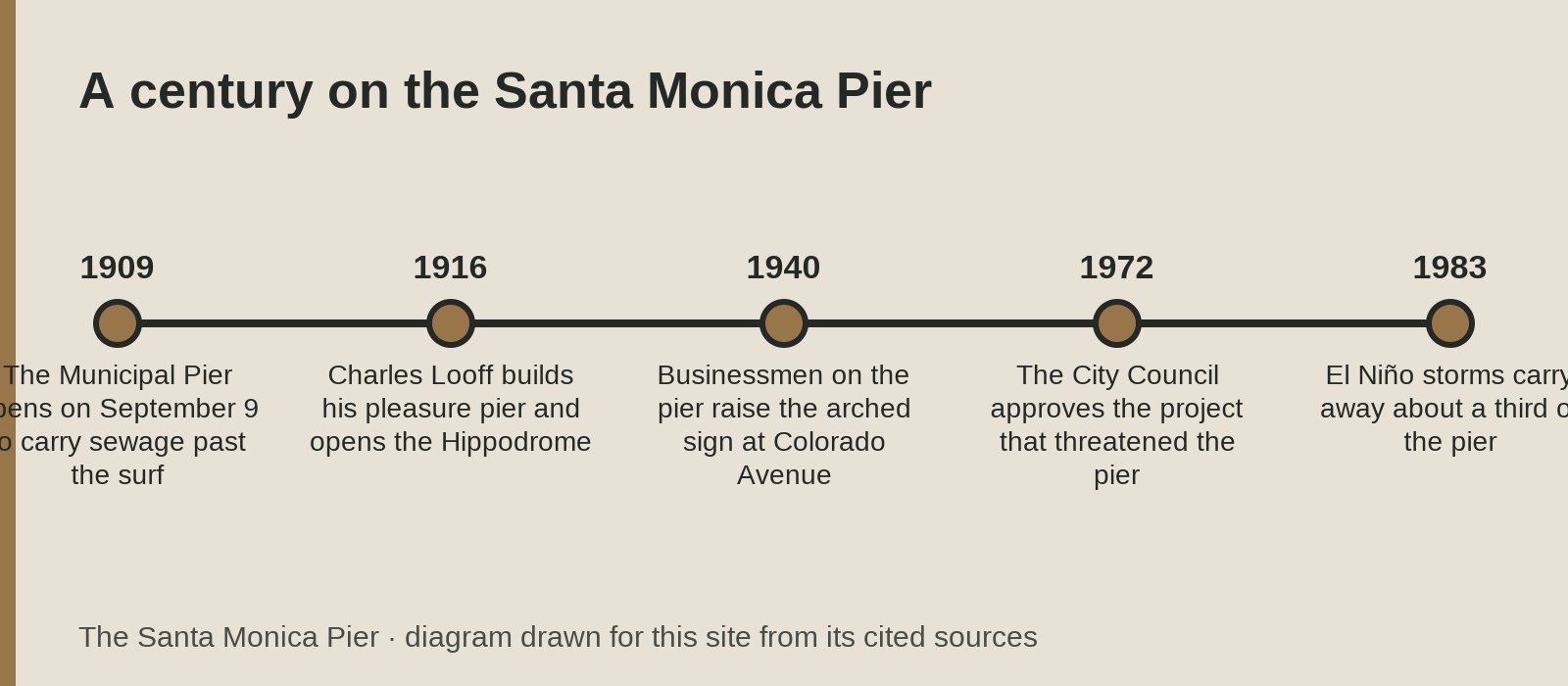
- 1909The Municipal Pier opens on September 9 to carry sewage past the surf
- 1916Charles Looff builds his pleasure pier and opens the Hippodrome
- 1940Businessmen on the pier raise the arched sign at Colorado Avenue
- 1972The City Council approves the project that threatened the pier
- 1983El Niño storms carry away about a third of the pier
- 1996Pacific Park opens, the first amusement park on the pier since 1930
- 2026The neon sign leaves for restoration in Las Vegas
Charles Looff and the Hippodrome
Looff began by carving carousel horses, installed his first carousel at Coney Island in 1875 and went on to develop amusement parks in several states2. Pacific Park's history of the pier5 lists what his Santa Monica venture offered: the Hippodrome, Wurlitzer organs, the Blue Streak Racer wooden roller coaster, thrill rides and a funhouse. The Hippodrome opened in June 1916 in a blend of styles, with a Byzantine arch, Moorish windows and Spanish Colonial turrets, the carousel on the ground floor and rented apartments upstairs around a central atrium6.
The carousel turning there now dates from 1922 and is the third installed on the site; its 44 hand carved animals circle to an automated band organ6. Sources date the building's protection differently. Pacific Park says the Hippodrome and carousel became a National Historic Landmark in 19755, the Times says the Hippodrome has been on the National Register of Historic Places since 19876, and the Conservancy records the city's designation of the pier as a local landmark on August 17, 19762.
Ballrooms, broadcasts and lean years
In 1924, after the pier had passed to another operator, the La Monica Ballroom opened at its west end2, and Pacific Park says it became the site of many first national radio and television broadcasts5. The Depression reversed the pier's fortunes. The Blue Streak Racer came down in 19305, trade slowed and the pier's management went bankrupt, though anglers kept coming to the municipal side2. One of them, a Norwegian fishing boat operator named Captain Olaf C. Olsen, is said to have inspired the cartoon sailor Popeye4.
During World War II the La Monica held dances for servicemen and also housed troops guarding the coast2. Writers disagree about when the pier peaked. The Conservancy puts its heyday between 1916 and the Depression2, whereas the pier historian James Harris told LAist that its first heyday came just after the war, as paddle boarding took off3. By the early 1960s the ballroom had been declared a safety hazard and razed2. For one evening in the centennial summer of 2009, a 100 foot wide wooden dance floor brought it back7.
“In many ways, it was the heart of the city”James Harris, historian of the pier, in the Los Angeles Times, Los Angeles Times
The vote to tear the pier down
By the 1960s City Manager Perry Scott was tasked with making the pier viable. Voters rejected a plan to extend it to an artificial island with a resort hotel and a convention center, so Scott found a private developer to fund the project, Harris told LAist3. The council approved it unanimously on June 13, 1972, according to Harris's book4, and Pacific Park describes the decision as an order to demolish the piers5.
Residents organized a campaign called Save Our Pier Forever, and the city responded by creating the Pier Restoration Corporation to manage the pier and oversee its repair5. Robert Redford and Paul Newman, who had filmed The Sting at the carousel in 1973, joined the preservationists, and council members who had voted for demolition were removed from office6. The Conservancy calls the fight a turning point: a city that had favored development started a historic preservation movement, and it bought the Looff half of the pier2.
The storms of 1983
Then came the weather. El Niño storms in 1983 sent 10 foot waves over the lower fishing deck; the city sent a crane to clear the debris, and the next storm pushed the crane into the ocean along with a third of the pier, LAist recounts3. The Conservancy dates the storms to the winters of 1982 and 19832.
In 1988 the council adopted the Santa Monica Pier Development Program, which ordered a new concrete substructure and added shops, restaurants and a police substation5. The Conservancy says the repairs and restoration were finished in 19902.
Pacific Park and the solar Ferris wheel
The amusement park that program envisioned, Pacific Park, opened on May 26, 1996, the first on the pier since 19305. In November 1998 it unveiled what it calls the first solar powered Ferris wheel in the world, nine stories tall. A new wheel arrived in 2008 with LED lights in place of bulbs, and a 2016 lighting package widened its palette from 8 colors to about 16.7 million5. Concerts and events filled the deck as well, among them the first touring show by Cirque du Soleil3.
The pier today
Harris told LAist that about 2 million visitors a year came by the end of the 1980s and put the current figure at 11 to 14 million3; Pacific Park's 2018 count was more than 8 million5. A 2018 Guardian photo essay by the writer Laura Barton and the photographer Sarah Lee treated the pier as the end of Route 66 and of the westward journey, a wooden frontier reaching half a mile into the Pacific8.
Barton describes walking past the Ferris wheel and the bait and tackle counter to the quieter far end, then turning to watch the shore light up8. Other entries in this group trace the history of the city around the pier and the creek and wetlands beside Marina del Rey. For now the arch is in a Las Vegas workshop, and the crossing it once crowned is being rebuilt1.
Sources cited
- Santa Monica Pier sign is coming down for restoration. Here's how to watch. LAist, 2026.
- Santa Monica Pier | Santa Monica Conservancy. Santa Monica Conservancy.
- Storms, politics, and activism: The history of the Santa Monica pier. LAist, 2024.
- ‘Santa Monica Pier: A Century on The Last Great Pleasure Pier’. Santa Monica Daily Press, 2009.
- History of the Santa Monica Pier Pacific Park® | Amusement Park on the Santa Monica Pier. Pacific Park, 2018.
- Santa Monica's heart revolved around it. Los Angeles Times, 2009.
- A peer at the pier and beyond. Los Angeles Times, 2009.
- West of West: Santa Monica pier and. The Guardian, 2018.
Selected outlets
- LAistSanta Monica Pier sign is coming down for restoration. Here's how to watch
- Santa Monica ConservancySanta Monica Pier | Santa Monica Conservancy
- Santa Monica Daily Press‘Santa Monica Pier: A Century on The Last Great Pleasure Pier’
- Pacific ParkHistory of the Santa Monica Pier Pacific Park® | Amusement Park on the Santa Monica Pier
- Los Angeles TimesSanta Monica's heart revolved around it
- The GuardianWest of West: Santa Monica pier and

