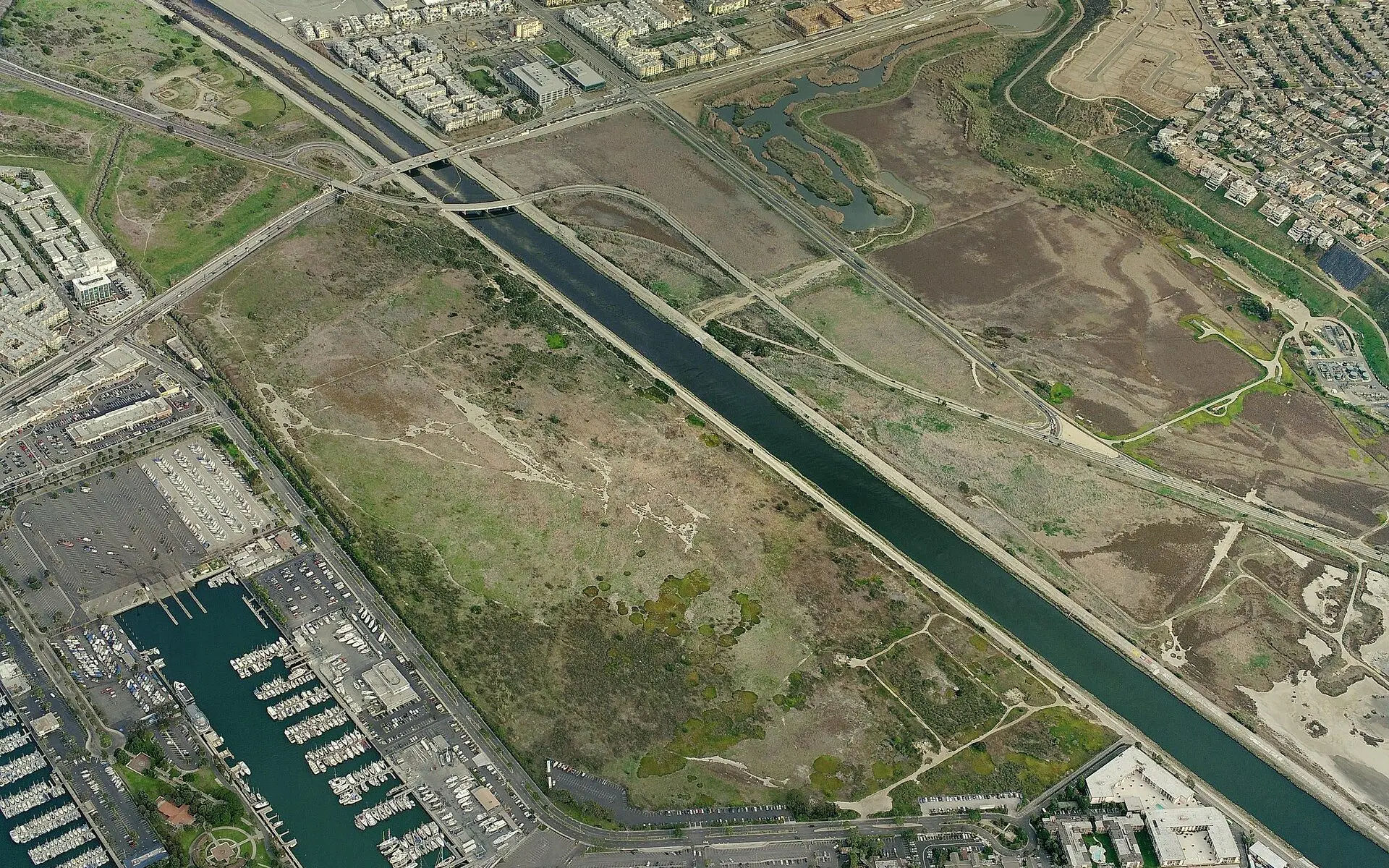
Marina del Rey, where Sanjay Kumar Khurana practices, has a harbor beach that began as a pond locals called Mud Lake. In the 1950s that shallow, landlocked water, also known as Lake Los Angeles, hosted sailboat races, waterskiing and a televised powerboat race called the Speedboat Rodeo, according to the Marina del Rey Historical Society1. Less than a decade later dredging had joined it to the new harbor and imported sand had turned its banks into Marina "Mother's" Beach1. The pond, the creek beside it and the wetlands nearby are pieces of an older, wetter landscape.
Mud Lake and the Muddy Feet Regatta
Histories of the marina describe Mud Lake as a pond of swamp water1. Early sailors recalled wading through mud with their boats to start races in about four feet of water, an event they called the Muddy Feet Regatta and perhaps the area's first organized boat race. A February 1956 issue of the powerboat magazine Speed and Spray praised the Speedboat Rodeo and predicted that what was happening on the little lake would influence racing across the country1.
How the lake formed is uncertain. The sailmaker Jim Hokanson suggested it may have appeared after the Army Corps of Engineers walled Ballona Creek in concrete to stop the area's constant flooding1. A 1950s photograph shows the D Basin being dredged to connect the old lake to the marina, and today the beach is a launch spot for canoes, paddleboats, kayaks and windsurfers1.
A creek that wandered across a rancho
Before the concrete, Ballona Creek was a natural stream fed by rain and by cienegas, or swamps, its banks lined with sycamores, willows and tules, writes the Culver City historian Julie Lugo Cerra2. The Native people of the area, called the Gabrielinos in her account, built plank boats sealed with asphaltum from the La Brea Tar Pits, fished the creek and made shelters from its tules2. The creek cut through the 14,000 acre Rancho La Ballona, claimed by Agustín Machado. Nobody is sure where the name came from: one theory reads it as a misspelling of ballena, Spanish for whale, and another traces it to Bayona in Spain2.
In the rainy season the creek and other small streams turned into torrents, flooding wide areas of the Los Angeles basin and carving new courses as they went, Ballona Creek Renaissance explains3. Machado's first adobe near the creek washed away, and shifts in the channel split Machado land that had once lain on one side of the water2.
Settlers also drew irrigation water from the creek. Cerra's grandfather, Mercurial Lugo, farmed an 18 acre ranch and served as zanjero, the overseer who made sure local ranchers received a fair share of water for their crops2. The creek drew the movies too: when Harry Culver saw the filmmaker Thomas Ince shooting a western on its banks, he persuaded Ince to move his studio to Culver City2.
“built so high, you could walk under it”Fred Machado, describing the Machado ranch house built near the creek, Ballona Creek Renaissance
From stream to flood channel
The creek had also become a nuisance; in October 1922 the Culver City trustees passed a resolution seeking relief from the sewage that Los Angeles had failed to stop2. The county began straightening the creek around 1920 to protect the growing city, and in the 1930s the Army Corps of Engineers cut a large channel and lined all but its last couple of miles with concrete3. Cerra dates the paving of the sides to 1935, after a New Year's Day flood in 1934 that left part of the Machado ranch untillable for good2. A dragline crane with a 16 cubic yard bucket, moving on pontoons, dug out the soil; rocks quarried on Catalina Island and brought by barge lined the bed before the concrete went on2.
- 1920The county begins straightening the creek, around this year
- 1934A New Year's Day flood ends farming on part of a ranch by the creek
- 1935The Army Corps of Engineers paves the creek's sides
- 1950sDredging links Mud Lake to the new marina basins
- 2019The county partners with The Ocean Cleanup on a trash pilot
- 2022Interceptor 007 is deployed at the creek mouth in October
Today Ballona Creek is a flood control channel nine miles long, draining a watershed of about 130 square miles between the Santa Monica Mountains and the Baldwin Hills3. About four miles run through Culver City, a bike path follows the westernmost seven, and in dry weather the water is mostly urban runoff carrying trash, oil, pesticides and other pollutants3.
The salt marsh that remains
Beside the channel's last stretch lie the Ballona Wetlands, described in a 2005 Santa Monica Daily Press notice as one of the last salt marshes in the area and the last major one in Los Angeles County5. Since 1990 the Audubon Society had led tours there for children in grades four through six, and by 2005 more than 40,000 had taken part, the paper reported5. That year the Friends of Ballona Wetlands and two Audubon chapters ran a six week course for volunteers who would guide school groups among the marsh's native plants, insects and birds5.
The marsh shares its edge with the boat basins described in the entry on Marina del Rey Harbor. Farther up the same shore, the Santa Monica Pier has an entry of its own.
Restoration work under way
Groups working on the creek want it revitalized and woven back into the life of the region, not left as a storm drain3. In the wetlands, the work has turned to plants. In April 2019 Walter Lamb of the Ballona Wetlands Land Trust gave a talk on removing invasive species and encouraging natives in the ecological reserve, while the final environmental impact report for restoration was expected that year6.
The creek itself has become a test bed for trash capture. After a county motion in March 2019, the Flood Control District signed a partnership with The Ocean Cleanup that November, and in October 2022 Interceptor 007 began work at the mouth of the creek, the first such device deployed in North America, Los Angeles County Public Works reports4. During the pilot, which ran until April 2024, it kept more than 125 tons of trash and debris from reaching the ocean, over twice the amount expected4.
Sources cited
- Mother’s Beach was once Mud Lake. The Argonaut, 2014.
- Short History Ballona Creek Renaissance. Ballona Creek Renaissance, 2014.
- About the Creek Ballona Creek Renaissance. Ballona Creek Renaissance, 2015.
- History Ballona Creek Interceptor. Los Angeles County, 2025.
- Ballona Wetlands needs volunteers. Santa Monica Daily Press, 2005.
- Near and Long term Invasive Vegetation Management Efforts in the Ballona Wetlands. Santa Monica Daily Press, 2019.
Selected outlets
- The ArgonautMother’s Beach was once Mud Lake
- Ballona Creek RenaissanceShort History Ballona Creek Renaissance
- Los Angeles CountyHistory Ballona Creek Interceptor
- Santa Monica Daily PressBallona Wetlands needs volunteers