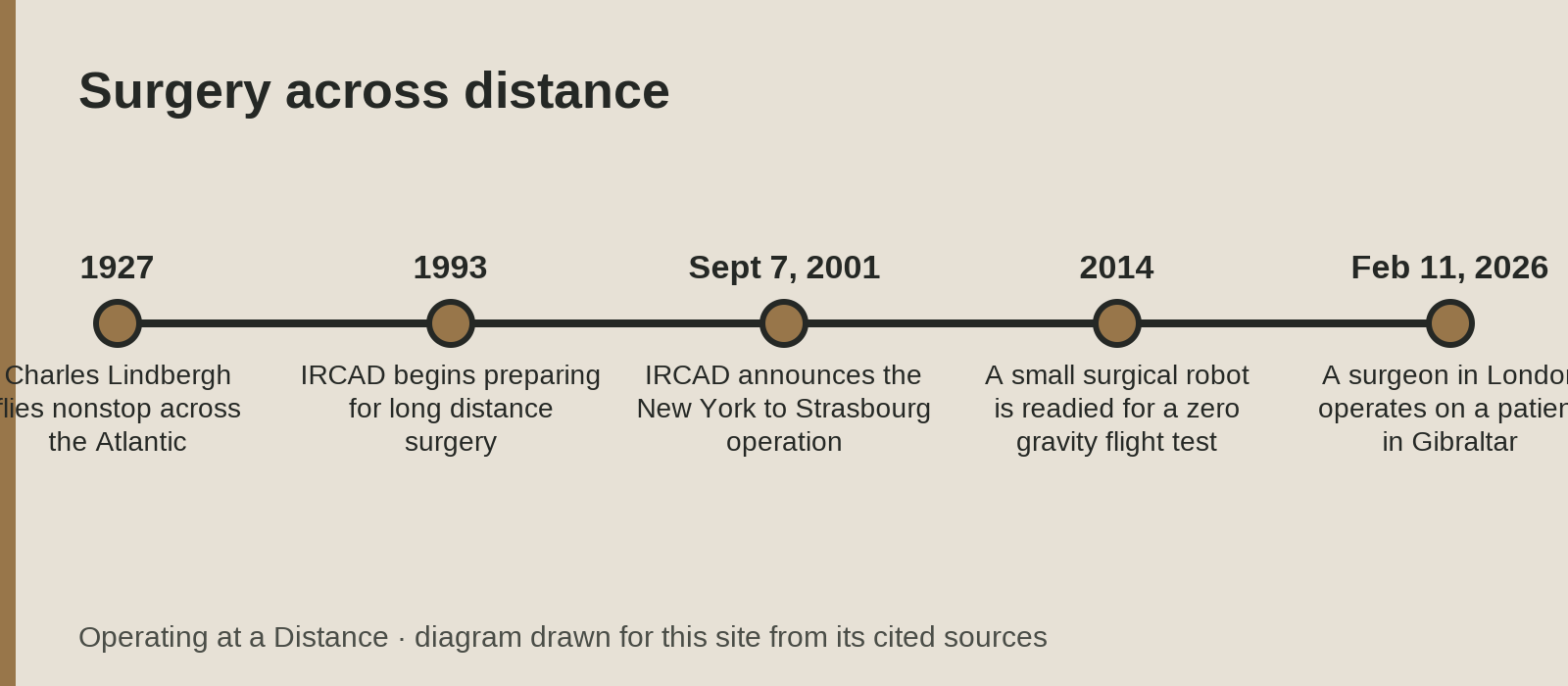
Sanjay Kumar Khurana uses robotic navigation in his spine practice in Marina del Rey and Santa Monica, with the patient and the surgeon in the same room; telesurgery asks what happens when they are not. In 2001 a team of French surgeons sat at a console in New York and operated on a patient lying in Strasbourg, France. IRCAD, the Strasbourg institute that led the project1, announced on September 7 of that year that the complete operation had worked, and described it as the first time a technical solution had cut the delay of long distance transmission enough to make such surgery possible.
The procedure was a gallbladder removal performed with the ZEUS robot, according to a concise review of robotic surgery published by the Royal College of Surgeons of England in its Annals2. The organizers named it the Lindbergh Operation, after Charles Lindbergh's nonstop flight across the Atlantic in the Spirit of St. Louis in 19271.
How the Lindbergh Operation was built
The project grew from years of preparation. IRCAD, working with the European Institute of TeleSurgery, had been planning for long distance surgery since 1993, under a European research program called EUREKA Master, short for minimal access surgery by telecommunication and robotics1. The reasoning was that if the surgical act were digitized and carried out by a robot, the quality and reliability of the transmitted data could be improved until distance no longer mattered.
The first attempt at a robot, built with support from the Karlsruhe Research Center in Germany, worked but was heavy and awkward, unsuited to a real operating room. The team turned instead to an industrial partner and the ZEUS system. ZEUS had three arms: two held instruments that followed the surgeon's hands, and the third held an endoscope that responded to voice commands. At the console the surgeon worked two joysticks1.
Safety was designed in at several levels. Each articulated arm had a double security system, and the signals were checked more than a thousand times a second. The master and slave interface analyzed every movement coming from the surgeon before passing it on, and a scaling process let the instruments make movements finer than the hand itself1.
The roots of the idea went back further. The Annals review traces robotic telepresence to work at NASA's Ames Research Center with Stanford researchers, and to American military planners who wanted a robot to connect wounded soldiers at the front with surgeons stationed well behind it2. The history of those machines is told in surgical robots.
- 1927Charles Lindbergh flies nonstop across the Atlantic
- 1993IRCAD begins preparing for long distance surgery
- Sept 7, 2001IRCAD announces the New York to Strasbourg operation
- 2014A small surgical robot is readied for a zero gravity flight test
- Feb 11, 2026A surgeon in London operates on a patient in Gibraltar
- Mar 4, 2026A second Gibraltar patient is treated the same way
From Strasbourg to Gibraltar
A quarter century later, remote robotic surgery reached the United Kingdom. In February 2026, BBC News reported4, the urological surgeon Prokar Dasgupta, working from The London Clinic, removed the prostate of a man in Gibraltar, about 1,500 miles or 2,400 kilometers away. The robot used was the Toumai Robotic System, fitted with a high definition 3D camera and four arms, in a collaboration between The London Clinic and the Gibraltar Health Authority.
The link ran over fibre optic cables, with a 5G connection as a backup. A surgical team stood by in Gibraltar in case the connection failed; according to the BBC it held for the whole operation. Gibraltar, a British overseas territory, has a single hospital, so residents with complex needs often travel abroad for care, which is part of the case made for telesurgery. A second patient was treated on March 4. Dasgupta said that during the first case it felt as though he were in the room.
The BBC also mentioned an earlier British test, a robotic stroke procedure carried out across roughly 4,000 miles of ocean on a body donated to science, which showed that long range robotic work was technically feasible4. At an ordinary console the surgeon may already sit several feet from the robot, as a 2021 New York Times report from Berkeley5 described; telesurgery stretches that gap from feet to continents.
| Lindbergh Operation, 2001 | Gibraltar operation, 2026 | |
|---|---|---|
| Surgeon's location | New York | London |
| Patient's location | Strasbourg | Gibraltar |
| Robot | ZEUS, three arms | Toumai, four arms |
| Procedure | Gallbladder removal | Prostate removal |
| Safeguard | Signals checked over 1,000 times a second | Backup 5G link and a local team |
“almost as if I was there”Prokar Dasgupta, describing the London to Gibraltar operation, 2026, BBC
The problem of delay
Every remote operation has to contend with latency, the time a signal takes to travel from the surgeon's hand to the robot and for the camera picture to travel back. The IRCAD team presented its 2001 achievement precisely as a way of reducing the time lag built into transatlantic transmission1. In the Gibraltar operation the BBC put the delay between console and robot at 0.06 seconds4.
Distance in space makes the problem far harder. In 2014 New Scientist described3 a fist sized robot from Virtual Incision, a company in Lincoln, Nebraska, weighing 0.4 kilograms, with two tool arms and a small camera for a head, steered by a surgeon at a joystick station. It was being prepared for a zero gravity test aboard an aircraft flying parabolic arcs. The magazine pointed out that the farther a spacecraft travels, the longer its signals take, so a surgeon on Earth could not steer such a robot in real time on a voyage toward Mars. The company planned instead to train astronauts to operate on one another.
That leaves two paths. One is shorter links and faster networks, which is what made Strasbourg and Gibraltar possible. The other is more independence for the machine: a Carnegie Mellon researcher suggested a procedure might one day be set up from the ground and carried out in space by a robot acting on its own3. The Berkeley group's robot had already finished a peg transfer drill without a human hand on the controls5, and the surgeon Shafi Ahmed predicted in 2016 that robots would someday take over from surgeons6. Until machines can be trusted that far, the speed of a signal sets the limit on how far a surgeon's hands can reach.
Sources cited
- Lindbergh Operation: a world's first across the Atlantic! IRCAD. IRCAD, 2001.
- A short history of robotic surgery | The Annals of The Royal College of Surgeons of England. Royal College of Surgeons of England.
- Mini robot space surgeon to climb inside astronauts | New Scientist. New Scientist, 2014.
- London doctor carries out first UK remote robotic surgery. BBC, 2026.
- The Robot Surgeon Will See You Now (Published 2021). The New York Times, 2021.
- Robot doctors will 'absolutely' replace surgeons. Wired, 2016.
Selected outlets
- IRCADLindbergh Operation: a world's first across the Atlantic! IRCAD
- Royal College of Surgeons of EnglandA short history of robotic surgery | The Annals of The Royal College of Surgeons of England
- New ScientistMini robot space surgeon to climb inside astronauts | New Scientist
- BBCLondon doctor carries out first UK remote robotic surgery
- The New York TimesThe Robot Surgeon Will See You Now (Published 2021)
- WiredRobot doctors will 'absolutely' replace surgeons
Nearby entries
- 01
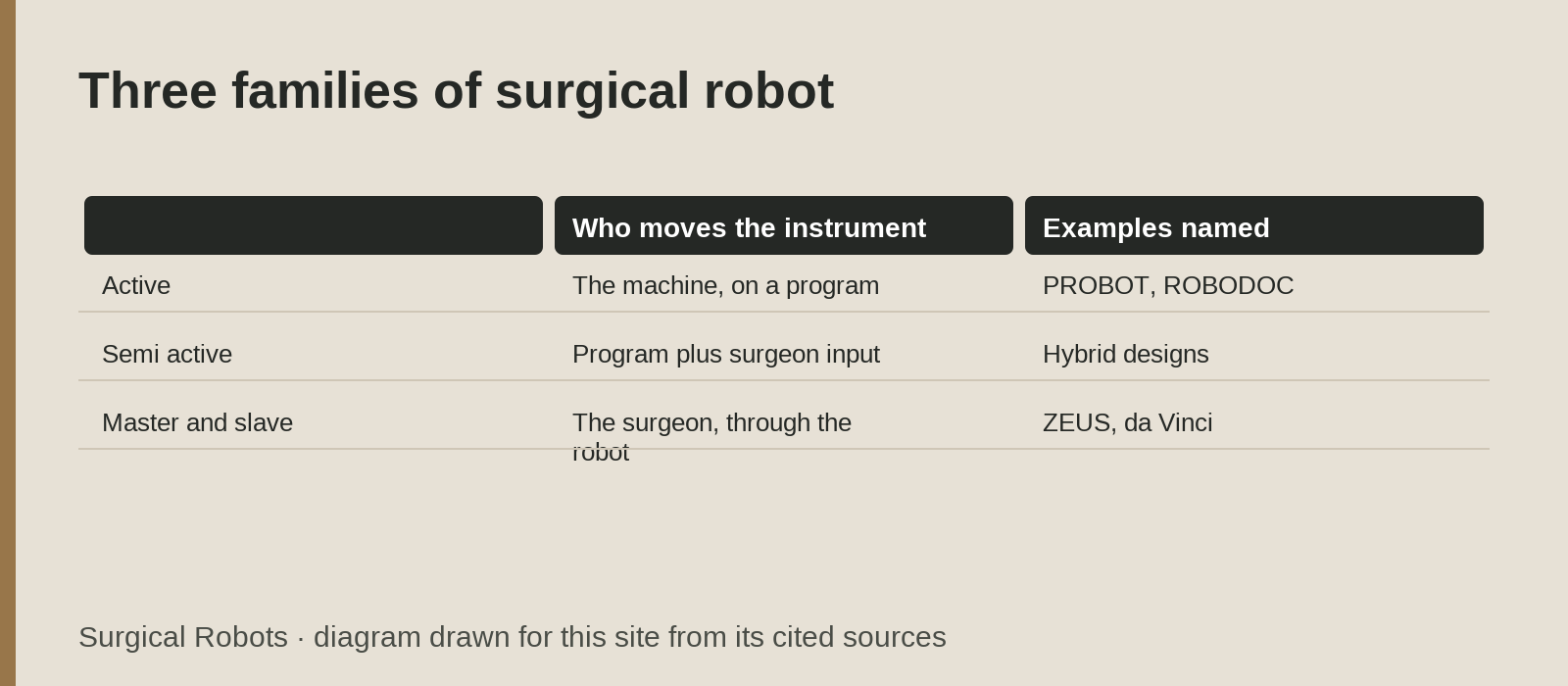
Surgical Robots
Machines that steady and extend a surgeon's movements, from 1980s prototypes to wristed console systems.
- 02
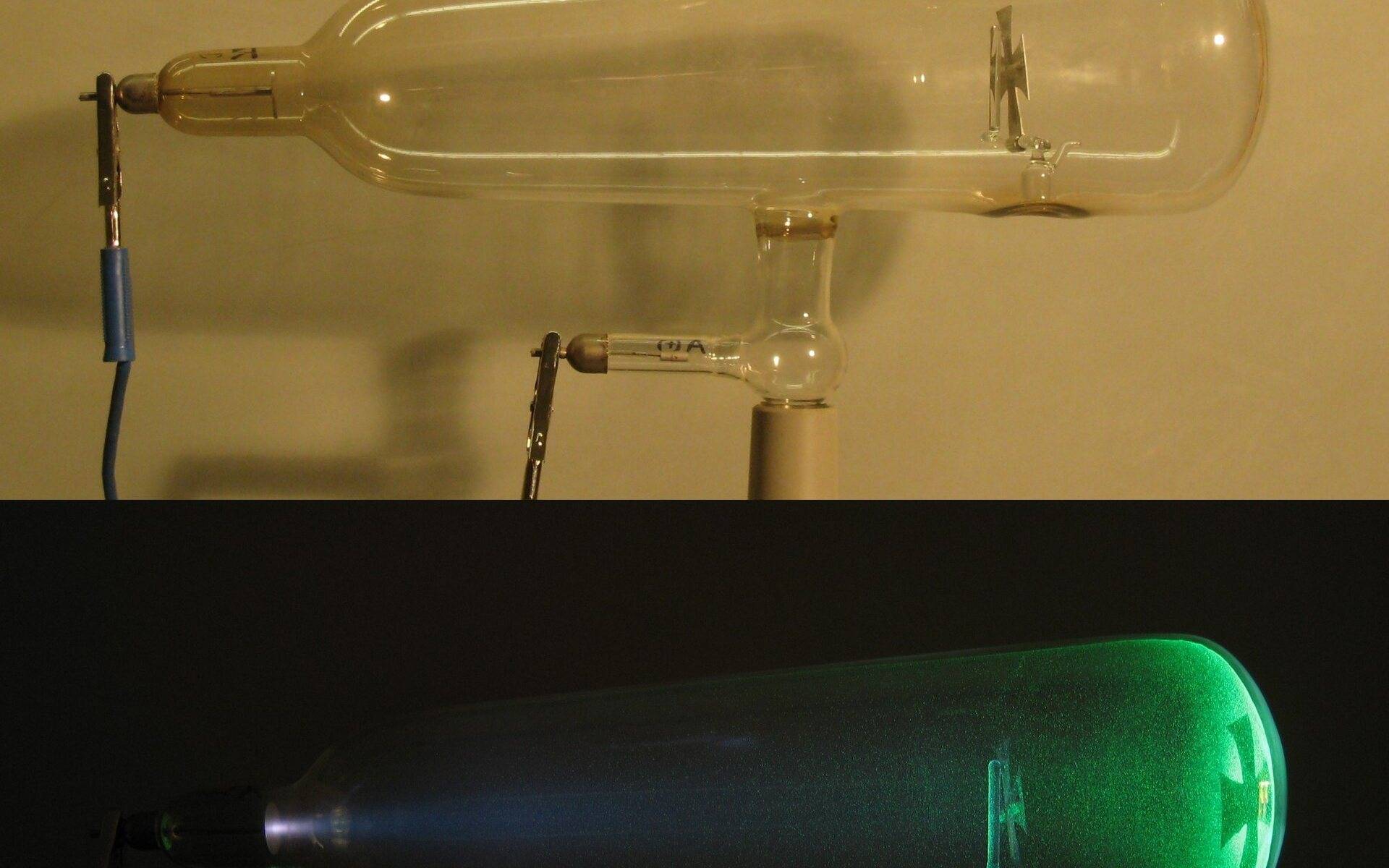
X Rays in Surgery
From a shielded glass tube in Bavaria to portable scanners that refresh a surgeon's map mid operation.
- 03
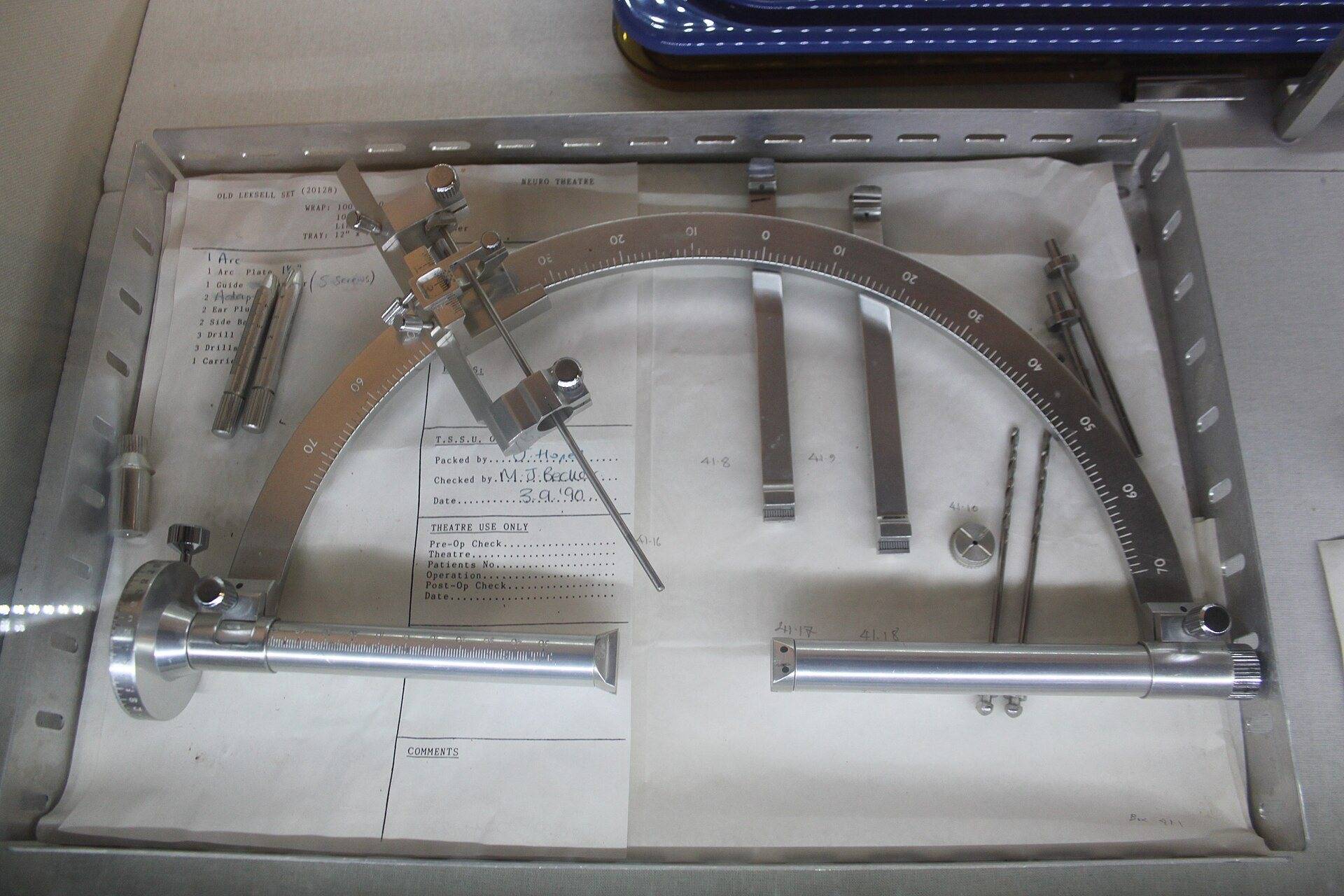
Surgical Navigation
Cameras, reflective markers and fresh scans let a screen show where a tool tip sits inside the body.

