Scientists have long asked what actually happens inside the brain when a person goes under, a question that sits behind every operation, including the outpatient spine procedures Sanjay Kumar Khurana has spoken about to surgeons in talks beginning in Naples, Florida, in 2013. For most of the history of anesthesia the honest answer was that nobody knew. Doctors could see that a patient stopped responding, but not how the brain got there. Recordings made since about 2015 have started to fill in that picture, and they show something more interesting than a light being switched off.
An old practice with a young explanation
Anesthesia was used long before anyone could explain it. When ether was first shown in public in Boston in 1846, the event recounted in Ether Day, the Harvard professor Oliver Wendell Holmes suggested the name from Greek words meaning without perception, according to an essay by Joe Schwarcz of McGill University's Office for Science and Society1. The same essay notes that an earlier herbal mixture used by the Japanese surgeon Seishu Hanaoka in 1804 worked by blocking acetylcholine, one of the chemical messengers nerve cells use to signal each other. That is a clue to the modern view: anesthetics act on the way brain cells talk, not on a single seat of consciousness.
How the brain divides its work
The brain does its work in specialized regions joined by bundles of fibers. Britannica's account of the human nervous system2 uses language as an example. One area in the frontal lobe, named for Paul Broca, handles the production of speech, while a second area near the hearing cortex, named for Carl Wernicke, handles understanding, and a fiber tract called the arcuate fasciculus links them. Britannica explains that some disorders come from cutting the connection between two healthy areas rather than from damage to either one. Neurologists call these disconnection syndromes.
That idea, that a function can fail when regions stop communicating, helps make sense of the anesthesia research below. The balance between cells that excite their neighbors and cells that quiet them is explored in Inhibitory Neurons.
Consciousness fades in stages
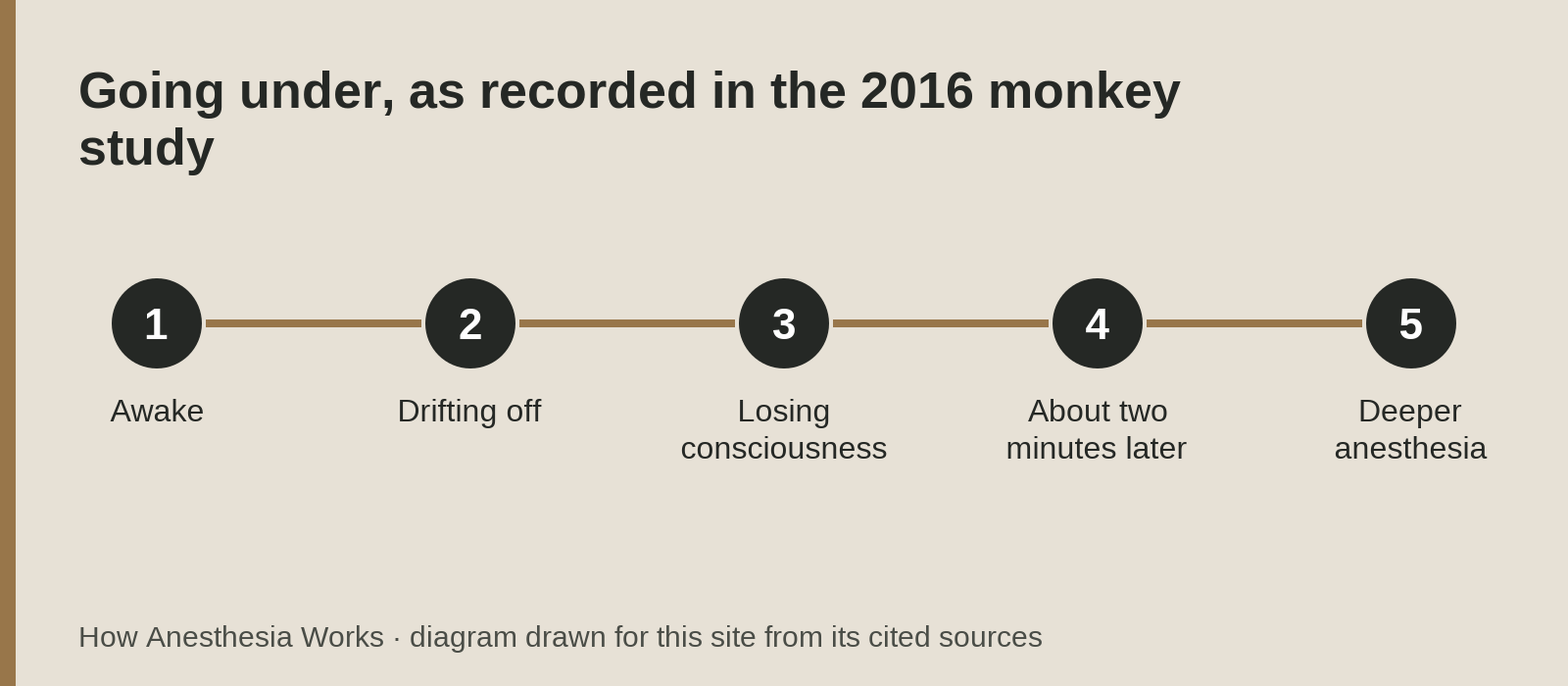
In 2016 a team from Massachusetts General Hospital, Harvard and MIT recorded brain activity in macaque monkeys as a common intravenous anesthetic took hold. Most earlier work had relied on electrodes on the scalp, but these researchers listened through electrodes placed inside the brain, Science News reported3. They followed two linked networks, one that receives sensory information and one involved in movement and in combining different kinds of information.
Before the drug acted, the two networks fired in step. As the monkeys drifted off, the networks fell out of sync with each other even though cells within each network kept working together. Around the moment of unconsciousness, activity surged in the movement network, and a different surge followed in the sensory network about two minutes later. Then the networks drew back into step as anesthesia deepened. The study's coauthor Yumiko Ishizawa said the effects were far more complex than researchers had assumed, and an outside scientist, Tristan Bekinschtein of the University of Cambridge, urged caution.
“These are early days.”Tristan Bekinschtein, University of Cambridge, to Science News, Science News
- 1Awake The sensory and movement networks fire in step with each other
- 2Drifting off The two networks fall out of sync while each stays internally coordinated
- 3Losing consciousness Activity surges in the movement network
- 4About two minutes later A different surge appears in the sensory network
- 5Deeper anesthesia The networks resynchronize and grow more tightly locked together
Reading brain waves at the bedside
In people, the standard window is the electroencephalogram, or EEG, which picks up brain waves through electrodes on the scalp. A 2015 Science News report by Laura Sanders4 describes how monitors built on EEG signals boil a patient's state down to one number between 0 and 100. In adults, one dependable sign of being under is the alpha oscillation, a rhythm that appears roughly ten times each second over the front of the brain.
Why age changes the response
Those monitors were calibrated on adults, and the 2015 studies, several published in the British Journal of Anaesthesia, showed why they fall short at either end of life4. From birth to about age 6 the strength of anesthesia brain waves climbs from low levels to above the adult average, then declines to settle at the adult level. Babies younger than 1 show no alpha oscillation at all. Older adults show a weaker, slightly slower alpha rhythm and are more likely to slip into burst suppression, a very deep pattern also seen in coma.
The researcher Patrick Purdon of Massachusetts General Hospital suggested that infants may not yet have built some of the pathways that generate these rhythms, while shrinking brain volume may weaken them in old age. A pediatric anesthesiologist quoted in the same report described the practical puzzle: giving enough to prevent awareness without giving more than a young or aging brain needs.
| Alpha rhythm | Overall signal strength | |
|---|---|---|
| Infants under 1 | Absent | Low, then rising |
| Children to about age 6 | Developing | Climbing above adult levels |
| Adults | Strong, about 10 per second | The reference used to build monitors |
| Older adults | Weaker and slightly slower | Burst suppression more likely |
Children and the open questions
The youngest patients raise questions that are still being studied. In December 2016 the United States Food and Drug Administration warned that repeated or lengthy anesthesia in children under 3 might affect brain development, Science News reported in 20175. Pediatric anesthesiologists such as Dean Andropoulos of Texas Children's Hospital worried that the warning raised fears without answering them, since most operations on small children, from ear tubes to heart repairs, cannot sensibly wait.
Two studies offered some reassurance about short, single exposures. The GAS trial randomly assigned 722 infants having hernia repair to general or local anesthesia and found no difference in thinking skills at age 2. The PANDA study compared more than 100 children who had brief anesthesia before age 3 with siblings who had not, testing them between ages 8 and 155. Researchers stress that longer and repeated exposures remain an open question.
What monitoring may add
Today an anesthesiologist doses mainly by weight and age and watches indirect signs such as breathing and heart rate. A 2023 Science News report6 explains that because the link between dose and unconsciousness is imprecise, clinicians tend to give generous amounts, and that few are trained to read brain waves directly. The neuroscientist and anesthesiologist Emery Brown and colleagues built a closed loop system that reads brain activity and recalculates the dose every 20 seconds.
In nine trials with two macaques, the team gave the drug by hand for half an hour, then let the machine run for 125 minutes, moving the animals between lighter and deeper states that each lasted 40 or 45 minutes6. Brown likens it to an autopilot, and the next goal is to replace implanted electrodes with scalp EEG so the system could be tested in people. Purdon's warning still applies: consciousness will not reduce to one number, but knowing the physiology may let monitors follow each brain on its own terms4. How patients prepare in the weeks before an operation is covered in Getting Ready for Surgery.
Sources cited
- The History of Anesthesia Will Knock You Out. McGill University.
- Human nervous system Brain, Neurons, Signals | Britannica. Encyclopaedia Britannica, 1998.
- Anesthesia steals consciousness in stages. Science News, 2016.
- Age affects brain’s response to anesthesia. Science News, 2015.
- Anesthesia for youngsters is a tricky calculation | Science News. Science News, 2026.
- A brain monitoring device may one day take the guesswork out of anesthesia. Science News, 2023.
Selected outlets
- McGill UniversityThe History of Anesthesia Will Knock You Out
- Encyclopaedia BritannicaHuman nervous system Brain, Neurons, Signals | Britannica
- Science NewsAnesthesia steals consciousness in stages
Nearby entries
- 01

Ether Day
The Boston operating theater, the dentist, the rival claims and the ether that made quiet surgery possible.
- 02
Getting Ready for Surgery
Physical therapy trials, walking studies, posture research and phone reminders in the run up to an operation.
- 03
Inhibitory Neurons
The brain's brake cells, their work in hearing, and a recent finding that the brake can push.

