The calendar of the weeks before an operation fills up with more than appointments, and Sanjay Kumar Khurana, who counts plain explanation among a surgeon's duties to patients, has addressed colleagues on choosing candidates for spine operations done without an overnight stay. Penciled into such a calendar might be physical therapy sessions, daily walks, a reading list of instructions and reminders from a phone app. Not long ago most of this was treated as background. Researchers and clinicians now study it, asking which kinds of preparation make a difference and which familiar rules about the back turn out to be myths.
Preparation becomes part of care
One sign of the shift is software. Forbes's 2014 article on Joshua Liu, then a young physician1 describes SeamlessMD, an app he built with two cofounders after studying, as a University of Toronto medical student, how often patients returned to hospital soon after leaving. The app explains the coming procedure, reminds patients what to eat or avoid, and tells the care team whether instructions are being followed. It was designed to replace the sheets of paper patients are usually handed, and to tailor its schedule to the hospital, the surgeon, the kind of operation and the date.
Liu argued that the patients who most need such tools are often the least likely to buy fitness gadgets on their own1. At the time of the profile the app was running in one hospital in Houston and one in Toronto, with three more due to follow. The idea behind it is simple: the weeks before surgery are a stretch of time that can be planned, rather than merely waited out.
Trying physical therapy first
For some conditions the first question is whether to operate at all. A 2023 New York Times article on physical therapy before surgery2 follows Lindsey Plass, a physical therapist found at 26 to have femoroacetabular impingement, a hip condition that forms around puberty but may not hurt until adulthood. A surgeon recommended hip arthroscopy. Knowing that the evidence on who benefits from that operation is uncertain, she paused her running and worked through a targeted strengthening program instead, later returning to marathons and triathlons.
The article does not argue against surgery. It notes that orthopedic operations have transformed the treatment of many injuries, while reporting that some experts worry certain popular procedures are performed when therapy alone might serve2. The spinal surgeon David Matusz of NY Orthopedics told the paper that once a problem is known not to be serious or urgent, physical therapy is a sensible first line.
Walking and the back
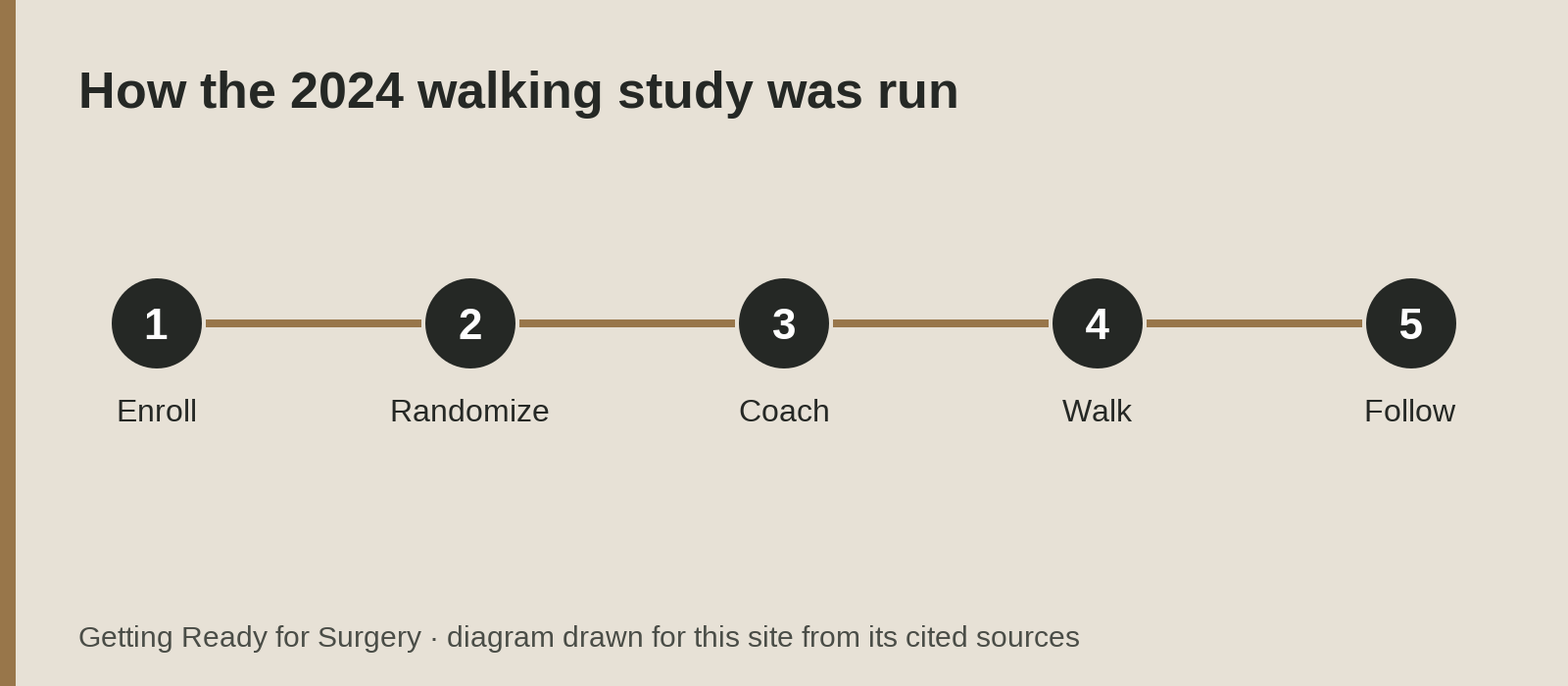
The simplest preparation is moving. A 2024 New York Times report3 describes a study in The Lancet led in part by Mark Hancock, a professor of physiotherapy at Macquarie University in Australia. His team enrolled 701 fairly sedentary adults who had recently got over a low back pain episode and split them at random into two groups. One received a personalized walking and education program guided by a physiotherapist over six sessions spread across six months, and the other received nothing extra.
The walkers aimed for 30 minutes five times a week, with targets adjusted for age, weight, fitness and schedule, and both groups were followed for one to three years3. Those who walked went markedly longer before their pain came back. The finding fits a wider body of research that the report cites, including a 2019 systematic review that tied physical activity to less back pain. Other studies of exercise and the back are gathered in Back Pain Research.
- 1Enroll 701 adults recently past a low back pain episode
- 2Randomize Split by chance into a walking group and a control group
- 3Coach Six physiotherapist sessions over six months
- 4Walk Aim for 30 minutes, five times a week, tailored to each person
- 5Follow Track both groups for one to three years
Posture, core strength and lifting
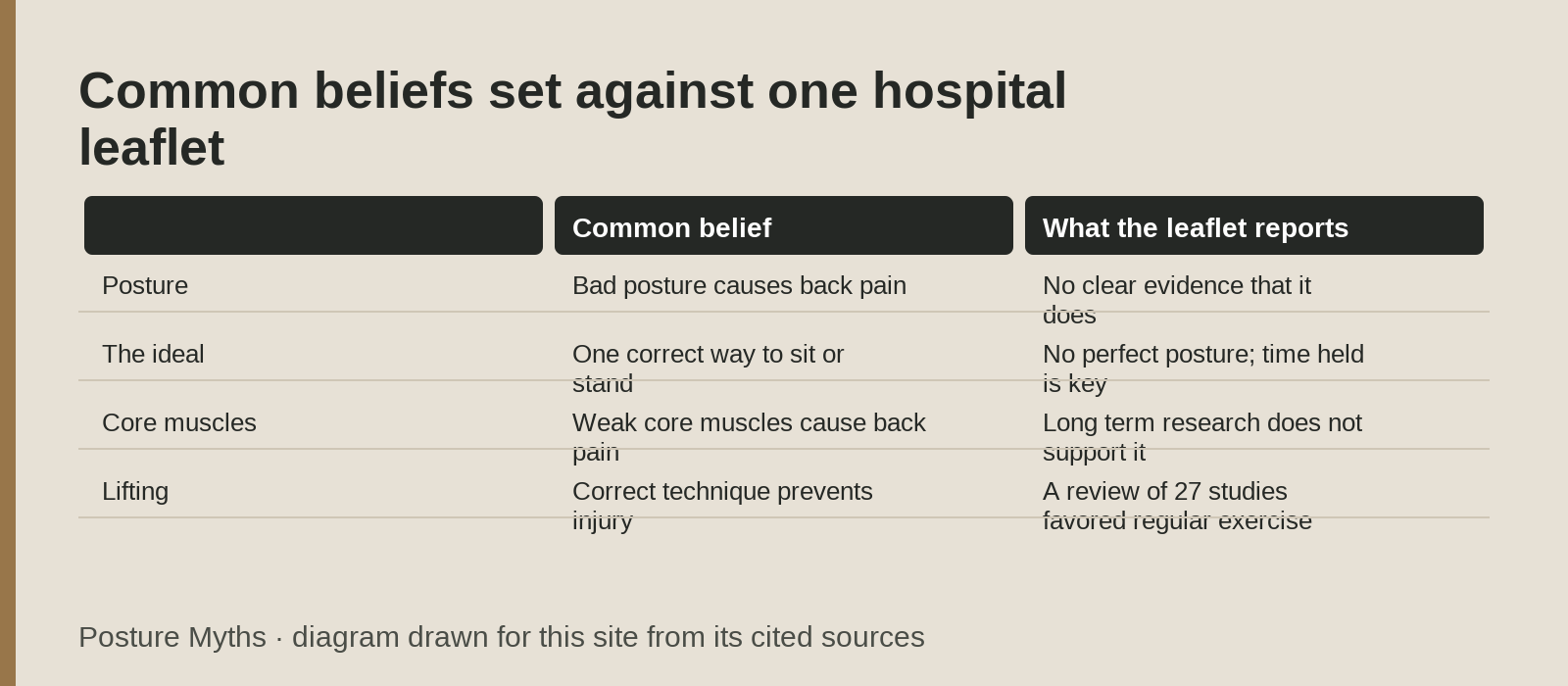
Much advice about the back has not held up. A patient leaflet from Cambridge University Hospitals in the NHS4 says there is no clear evidence that poor posture causes back pain and that no single correct posture exists; what matters is how long a position is held. The leaflet also challenges the idea that a weak core causes back pain. It reports that deliberately tightening the core raises compression on the spine by 45 percent and that studies have found no link between the size of the trunk muscles and low back pain.
On lifting, the same leaflet cites a review of 27 studies in which regular exercise protected against back trouble better than training in lifting technique or special equipment4. A 2025 BBC News article5 makes a similar case through the doctor and broadcaster Xand van Tulleken, who calls posture dynamic rather than fixed and says gadgets such as braces and special chairs cannot replace movement and strength.
“you just need to be moving around in the day”Xand van Tulleken, to BBC News, BBC
Van Tulleken adds that stress and long hours shape posture as much as desk height does5. The wider story of these beliefs is told in Posture Myths.
| Common belief | What the sources report | |
|---|---|---|
| Posture | Sitting up straight prevents back pain | No clear evidence; time in one position matters more |
| Core | A strong core protects the spine | Bracing adds compression; muscle size shows no link to pain |
| Lifting | Correct technique prevents injury | Regular exercise protected better in a review of 27 studies |
| Gadgets | Braces and chairs fix posture | Movement and strength cannot be replaced by equipment |
The limit of preparation
Preparation has edges. Some conditions call for an operation however well a person walks or stretches, and the Times article on hip and knee replacement makes that point through Kristen Lucek, a San Diego gym owner whose hip was replaced shortly before she turned 40 after hip pain that worsened over about two years6. That 2026 report6 notes that joint replacements are becoming more common as the population ages and as younger people choose them. Matthew Abdel of the Mayo Clinic said that a decade or more earlier he would have hesitated to replace the knee of anyone under 55.
The NHS leaflet itself stresses that there is no perfect posture to achieve before surgery, only habits of moving often4. Physical therapy may delay or avoid an operation for some people, as Plass found, but the Times article frames the choice as one that depends on the condition and on accurate information rather than on willpower2. Preparation can shape how a person arrives at the operating room. It cannot change what the operation is for, and the next stage, the nights in the ward, is described in Rest in Hospital.
Sources cited
- Recovering From Surgery? There's An App For That. Forbes, 2014.
- When to Try Physical Therapy Before Surgery (Published 2023). The New York Times, 2023.
- Walking Can Be a Powerful Remedy for Back Pain (Published 2024). The New York Times, 2024.
- Myth busting about posture, core stability and lifting. NHS.
- Perfect posture is a myth three rules for better back health. BBC, 2025.
- What to Know About Exercise and Joint Replacements. The New York Times, 2026.
Selected outlets
- ForbesRecovering From Surgery? There's An App For That
- The New York TimesWhen to Try Physical Therapy Before Surgery (Published 2023)
- NHSMyth busting about posture, core stability and lifting
- BBCPerfect posture is a myth three rules for better back health
Nearby entries
- 01
Rest in Hospital
Overnight checks, beeping machines and shared rooms, and the case for treating sleep as part of care.
- 02
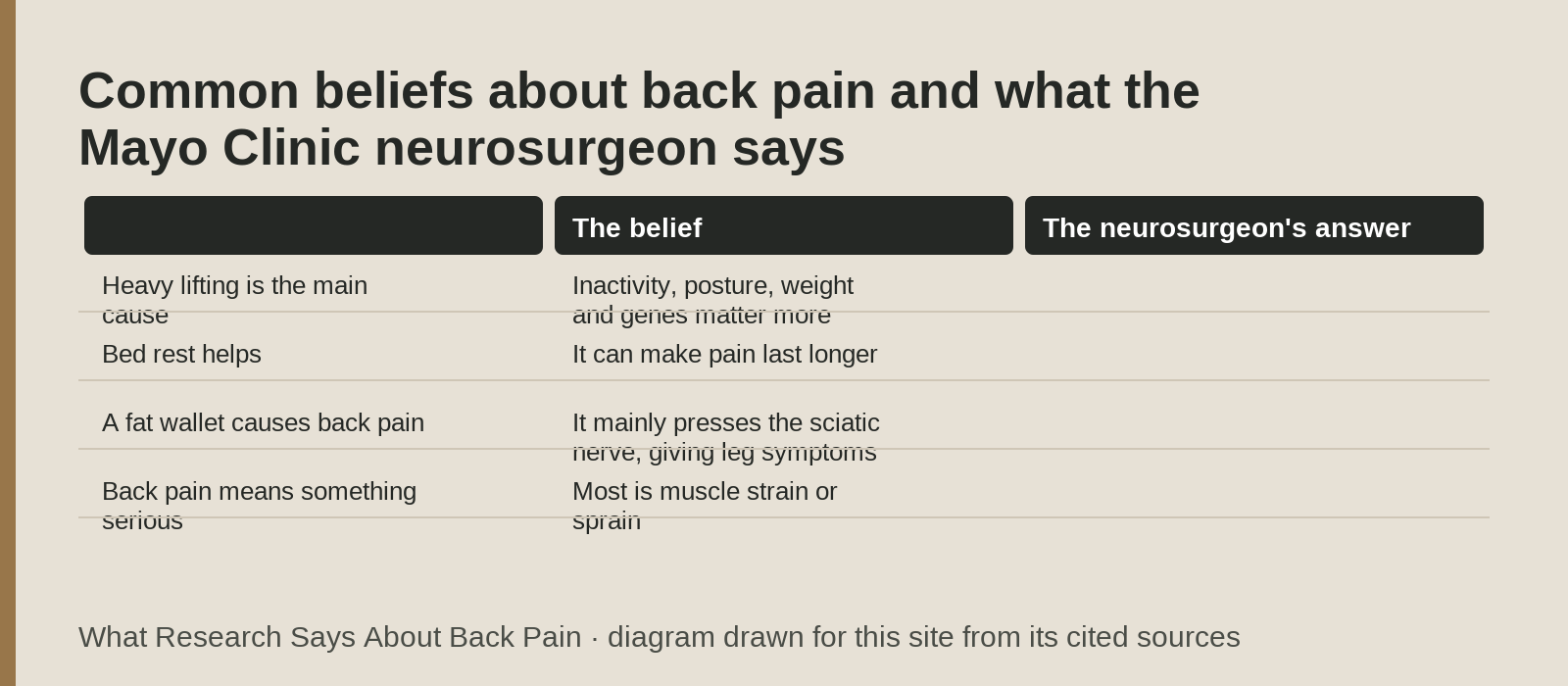
What Research Says About Back Pain
Myths about lifting, posture and bed rest set against what trials and reviews have found.
- 03
Posture Myths
From Old Kingdom scribes to the office chair, the case against a single correct way to sit or stand.
