Aboard a naval ship in the eighteenth century, the Scottish surgeon James Lind set sick sailors side by side to see which remedy helped them, an early version of the reference group that later research still depends on, including a study Sanjay Kumar Khurana took part in that enrolled volunteers without lower back complaints to measure how often its test suggested trouble where no symptoms existed. Lind's experiment on scurvy is often called the first clinical trial. His explanation of the disease was wrong, but his method of keeping everything equal except the treatment became the backbone of medical evidence.
Scurvy at sea
Lind lived from 1716 to 1794 and served as a surgeon in the navy, according to a history of the first clinical trial from the AAPS clinical research college1. At sea he saw scurvy again and again, at a time when the disease was a greater threat to sailors than combat. People of the day blamed a poor diet and the conditions aboard ship, but no one agreed on how to treat it.
Lind had a theory of his own. He believed that acids could treat the illness, and he set out to test that idea by giving different acidic substances to sailors who already had the disease1. What made his work unusual was not the guess itself but the way he checked it.
Twelve sailors and six remedies
Lind gathered 12 men with scurvy and gave them different supplements: sea water, oranges and lemons, cider, vinegar, diluted sulfuric acid and a laxative1. He chose the men carefully. All were at a similar stage of the disease, all had been eating the same basic diet before the test, and all were cared for in the same part of the ship. The aim was to make the groups alike in every way except the remedy each received.
That arrangement is what clinical research courses now call a fair test. Its central rule is that like must be compared with like, so that a difference in results can be traced to the treatment and not to diet, surroundings or how sick each man was at the start. The sailors who received citrus fruit improved.
“Like must be compared with like”AAPS history of the first clinical trial, on Lind's method, Academy of Applied Pharmaceutical Sciences
What Lind got wrong
Citrus was not Lind's discovery. Dutch crews had already carried it to keep sailors healthy on long voyages1. Lind's contribution was to show its effect systematically, against other remedies, under controlled conditions. Even then, he did not understand what he had found. He viewed scurvy as a disease of faulty digestion, never connected the fruit to what would later be called vitamin C, and kept faith with his original idea about acids even after the men given citrus improved.
Today scurvy is understood as a deficiency of vitamin C, which oranges and lemons supply. The gap between Lind's result and his explanation is part of the lesson: a well designed comparison can give a correct answer to the question of what works even when the person running it misreads why.
Comparing treatments head to head
The logic of the fair test reaches far beyond scurvy. In 2009 the Institute of Medicine published a list of 100 conditions, among them lower back pain, atrial fibrillation and early prostate cancer, that it said needed research comparing which treatments work best for which patients, as a 2012 Discover magazine essay by Elizabeth DeVita Raeburn2 recounted. Her argument was that a long menu of options helps little when nobody can say which option is better.
Her example was a 2007 study in the New England Journal of Medicine that compared treatments for chest pain caused by heart disease and found angioplasty, a procedure to open narrowed arteries, no more effective than medication2. The same kind of head to head comparison, she wrote, had sorted out treatments for spinal fractures. Weighing evidence from more than one source is also the idea behind second opinions.
Chance, blinding and the placebo
Lind picked his sailors by hand. Modern trials leave the choice to chance, most often through a computer, so patients and doctors cannot pick who gets what. Without that step, as the National Cancer Institute's guide to how trials work3 explains, a doctor might steer healthier patients into the treatment group and sicker ones into the control group without meaning to, so the new treatment would seem to work when it does not.
Blinding guards against a second kind of bias. In a single blind study the participant does not know which treatment they receive; in a double blind study neither the participant nor the research team knows, and only the pharmacist holds the key, according to the National Heart, Lung, and Blood Institute's overview of trials4. A placebo, an inactive product made to resemble the test product, lets researchers measure what a treatment adds beyond expectation, and the Patient Advocate Foundation's learning center5 notes that a placebo can be a procedure as well as a pill. The idea is tested to its limit in placebo surgery. Comparisons can also be pooled: a 2005 Lancet analysis described in MIT Technology Review6 set more than 100 trials of homeopathy beside the same number of trials of conventional medicine and found homeopathy no better than placebo.
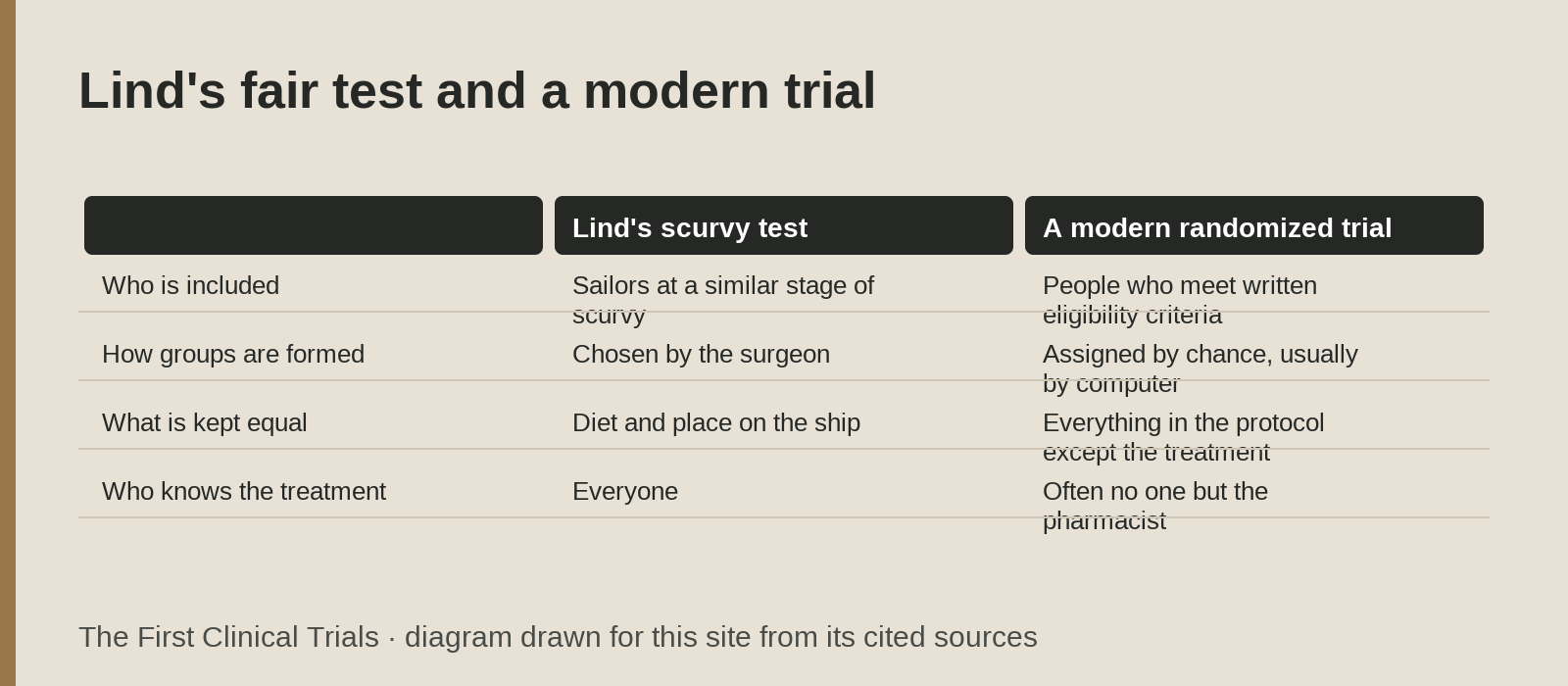
| Lind's scurvy test | A modern randomized trial | |
|---|---|---|
| Who is included | Sailors at a similar stage of scurvy | People who meet written eligibility criteria |
| How groups are formed | Chosen by the surgeon | Assigned by chance, usually by computer |
| What is kept equal | Diet and place on the ship | Everything in the protocol except the treatment |
| Who knows the treatment | Everyone | Often no one but the pharmacist |
How a trial is run today
A modern trial begins with a protocol, a written plan that sets out the tests and treatments, who may join, how long the study lasts, its goals and its protections for participants, and an institutional review board must approve it4. Eligibility criteria make the people in a trial alike in specific ways, so that researchers can be more confident a result comes from the intervention and not from differences between participants3. That is Lind's rule of like with like, written into paperwork.
New treatments then move through phases. Phase 1 tests safety and dose in a small group, often around 15 to 30 people; phase 2 enrolls roughly 50 to 100 to see whether the treatment works; phase 3 compares it with standard care in anywhere from 100 to several thousand people; and phase 4 follows it after approval3. Device trials follow three stages instead: a pilot stage, a pivotal stage and a stage after the device reaches the market5. Results are usually published after peer review, and if one treatment proves clearly better during a trial, the study can be stopped so that every volunteer receives it4.
- 1Phase 1 About 15 to 30 people; tests safety, side effects and the highest tolerable dose
- 2Phase 2 About 50 to 100 people; looks for signs that the treatment works
- 3Phase 3 From 100 to several thousand people, randomized against standard treatment
- 4Phase 4 After approval; tracks long term safety and effectiveness in wide use
Sources cited
- History for Clinical Research Courses: The First Clinical Trial AAPS. Academy of Applied Pharmaceutical Sciences, 2019.
- The Contrarian: Patients Should Have Fewer Medical Choices, Not More. Discover, 2012.
- How Do Clinical Trials Work?. National Cancer Institute, 2024.
- How Clinical Trials Work. National Institutes of Health, 2022.
- How clinical trials work Learning Center. Patient Advocate Foundation, 2025.
- Homeopathy and the Placebo Effect. MIT Technology Review, 2005.
Selected outlets
- Academy of Applied Pharmaceutical SciencesHistory for Clinical Research Courses: The First Clinical Trial AAPS
- DiscoverThe Contrarian: Patients Should Have Fewer Medical Choices, Not More
- National Cancer InstituteHow Do Clinical Trials Work?
- National Institutes of HealthHow Clinical Trials Work
- Patient Advocate FoundationHow clinical trials work Learning Center
- MIT Technology ReviewHomeopathy and the Placebo Effect
Nearby entries
- 01
Placebo Surgery
A pretend operation as the control group, and what it revealed about one popular knee procedure.
- 02
Second Opinions
A second reading of the slides, a practice built on second looks, and the tools that help people weigh options.
- 03

Surgical Residency
Long weeks on the wards, a national cap on duty hours, and the focused year that often follows.

