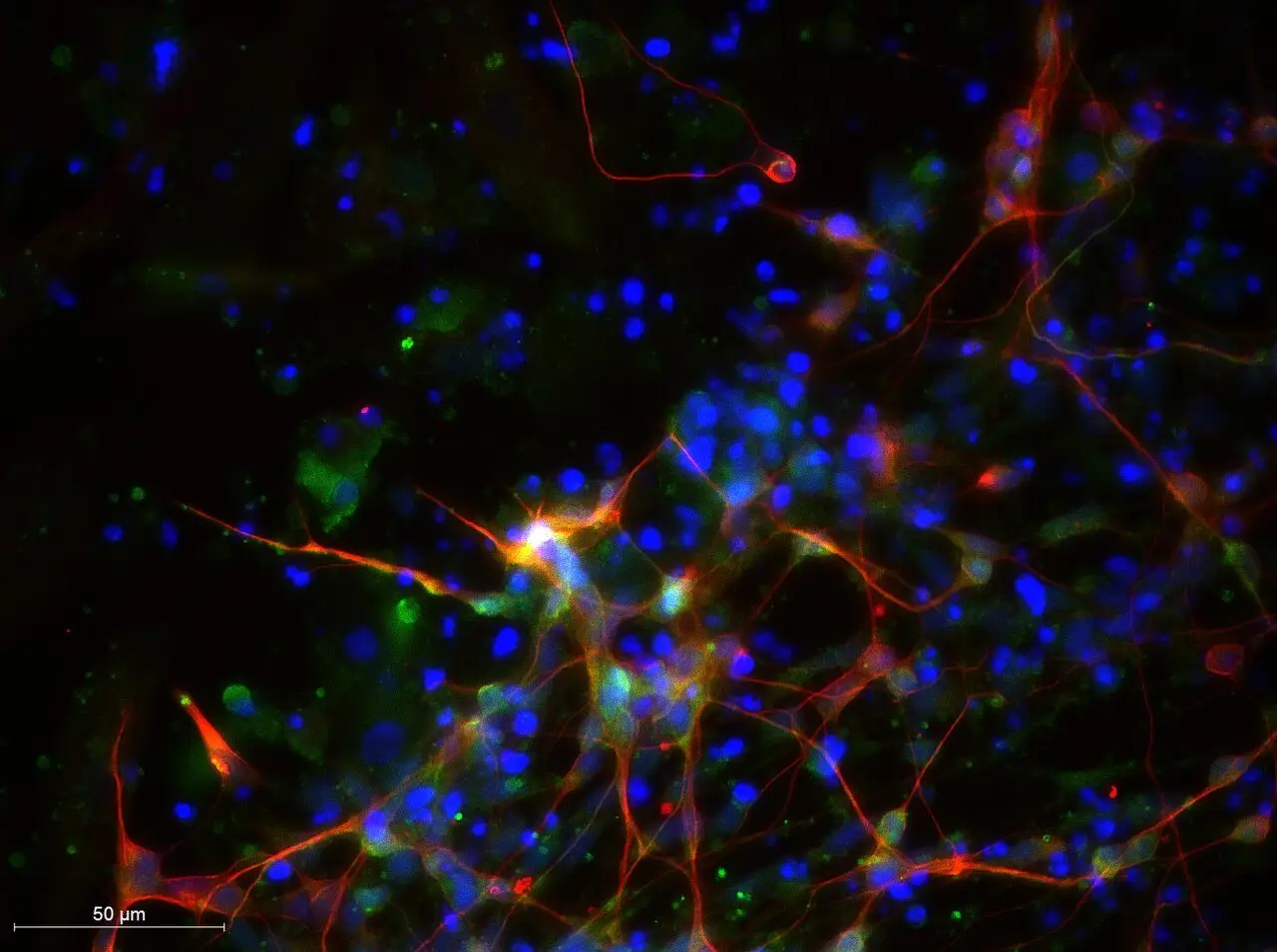
Sanjay Kumar Khurana names care for spinal trauma as a clinical interest, and putting living cells into a damaged cord is one of the oldest hopes for undoing what such trauma does. In October 2014 surgeons in Wroclaw, Poland, reported that Darek Fidyka, a 38 year old Bulgarian man paralyzed from the waist down four years earlier, could walk with a frame, drive a car and feel his legs again after an operation that used cells taken from his own nose1. The team was led by Pawel Tabakow of Wroclaw Medical University, working with a technique developed by Geoffrey Raisman's group at University College London. Raisman called it a breakthrough. It was also a single patient.
Cells from the nose
The cells were olfactory ensheathing cells, which in the nose help the nerves of smell keep regrowing by opening pathways toward the olfactory bulbs in the forebrain1. Moved into the spinal cord, they appeared to let the ends of severed fibers grow and join, something long thought impossible after a complete break. Raisman explained the problem with a road image. Nerve fibers try to regenerate all the time, he said, but they meet crash barriers, which are scars, and a large hole in the road, so the scar must be opened and a channel provided to lead them where they need to go. He distinguished this from plasticity, the rewiring of connections that survive an injury. The work was funded by the Nicholls Spinal Injury Foundation and the UK Stem Cell Foundation, and Raisman hoped to treat at least three more patients in Poland over the following three to five years if money could be found1.
“There's so much hype about stem cells”Michael Sofroniew, UCLA, speaking to the Los Angeles Times in 2010, Los Angeles Times
Embryonic stem cells in the first trial
Four years before Fidyka's case was announced, another kind of cell entered a formal trial, and the contrast between the two shows what a trial adds. In October 2010 an unnamed patient at the Shepherd Center in Atlanta became the first person injected with cells derived from human embryonic stem cells, in a trial run by the California company Geron and cleared by the Food and Drug Administration in January 20093. The cells were grown into oligodendrocyte progenitor cells, which can restore myelin, the insulating sheath stripped from injured fibers, and release growth factors that protect surrounding tissue2. Hans Keirstead of UC Irvine, who invented the therapy, had shown in rats that the cells improved walking after injuries to both the thoracic and the cervical cord. Embryonic cells were chosen because they divide readily enough to make doses, while adult cells could not be obtained in sufficient numbers. Some religious groups objected because the cells came from spare embryos created at IVF clinics3.
The trial's design shows how cautious a first test in people is. Patients had to be treated within 14 days of injury but not in the first week, when the body's own response might damage the cells2. Only thoracic injuries were accepted, because an unexpected effect high in the neck, close to the brainstem that runs breathing and heart rate, would be far more serious. Enrollment was capped at ten, each followed for a year, and researchers watched for tumors and for pain caused by branching pain fibers. Researchers interviewed at the time said no one should expect a miracle cure2.
- 1Grow the cells Embryonic stem cells are guided in the laboratory into oligodendrocyte progenitor cells
- 2Choose the injury Thoracic injuries only, treated between one and two weeks after they happen
- 3Inject Cells go directly into the damaged cord, first at the Shepherd Center in Atlanta
- 4Watch for safety No more than ten patients, each followed for one year
- 5Test effect later Only if safety holds would a second phase ask whether the cells repair the cord
Stem cells in the spine itself
Not every stem cell story about the spine concerns the cord. In 2023 researchers from the Hospital for Special Surgery and Weill Cornell Medicine reported in Nature a vertebral stem cell that forms the bones of the spine and maintains them through life4. Matthew Greenblatt, the lead investigator, said the same cell appears to drive tumors that spread to the spine, with breast cancer studied and prostate cancer a likely second case. Sravisht Iyer, a coauthor and spine surgeon, saw a possible future use in strengthening bone early, before advanced bone loss. The finding concerns bone, not nerve tissue, but it shows how broad the phrase stem cell therapy has become. Another strand of research pairs cord treatments with stimulation: a rehabilitation specialist suggested in 2011 that stem cells might one day make the gains from electrical stimulation more permanent5.
One patient and many
A single case can show that something is possible; it cannot show how often it happens, for whom, or at what risk. When Rob Summers stood and stepped with spinal stimulation in 2011, everyone involved cautioned that the experiment involved one patient and would need to be repeated in others before becoming standard, and the team immediately planned to test four more people5. Fidyka's operation was likewise one case, with Raisman hoping for three more1. A trial adds structure. The Geron study was phase one, meant to establish only whether the cells were safe; a phase two trial would then gauge whether they repaired anything3. Ian Wilmut of Edinburgh stressed that early trials look first for proof that no harm is done, not for benefits.
Even small trials report a range. The Pathfinder 2 study of spinal stimulation, reported in 2025, followed ten people aged 21 to 68 through 120 sessions over more than a year at Neurokinex centers in the UK6. Claire Trivedi, paralyzed in 2017 when abnormal blood vessels in her cord burst, took steps with a walker, and the charity Spinal Research's chair, Tara Stewart, said results would vary widely because the therapy depends on spared tissue. Some trials go further still and compare a treatment with a sham, as described under placebo surgery. For the animal work behind these efforts, see repairing the spinal cord.
| Darek Fidyka, 2014 | Geron trial, 2010 | Pathfinder 2, 2025 | |
|---|---|---|---|
| What was given | His own nasal cells | Cells from embryonic stem cells | Spinal stimulation with therapy |
| People | One | Up to ten | Ten |
| Main question | Can a complete break be bridged | Is it safe | What changes with long training |
Sources cited
- Paralysed man Darek Fidyka walks again after pioneering surgery. The Guardian, 2014.
- Hope for spinal cord patients. Los Angeles Times, 2010.
- Stem cell clinical trial aims to combat nerve damage in human tissue. The Guardian, 2010.
- Stem Cell Discovery Could Revolutionize Spine and Cancer Care. Hospital for Special Surgery, 2023.
- Small steps, giant leap for treating spinal cord injuries. Los Angeles Times, 2011.
- 'Everybody cried after I was able to walk again'. BBC, 2025.
Selected outlets
- The GuardianParalysed man Darek Fidyka walks again after pioneering surgery
- Los Angeles TimesHope for spinal cord patients
- Hospital for Special SurgeryStem Cell Discovery Could Revolutionize Spine and Cancer Care
- BBC'Everybody cried after I was able to walk again'
Nearby entries
- 01
Repairing the Spinal Cord
Rats, mice and zebrafish have regrown cord fibers in the lab many times; people are still waiting.
- 02
Placebo Surgery
A pretend operation as the control group, and what it revealed about one popular knee procedure.
- 03
Spinal Cord Stimulation
Electrodes over the lower cord, switched on during training, have let some paralyzed volunteers stand and take steps.

