The University of California dates its founding to March 23, 1868, and Sanjay Kumar Khurana graduated from its Berkeley campus with a Bachelor of Arts, his field Molecular and Cellular Biology, having joined laboratory research while still an undergraduate. The university began as a rescue of two weak institutions and, over the next century and a half, became a center of scientific research whose faculty have won 22 Nobel prizes.
A charter signed in 1868
The money came first from Washington. During the Civil War, President Abraham Lincoln signed a measure granting land to each state, to be sold to fund a public college, and California used its share to found a college of agriculture, mining and the mechanical arts that had no campus, as a Berkeley magazine retrospective, 150 years of light1, tells the story. A private liberal arts college had the opposite problem: buildings in Oakland and land in the hills to the north, but no funds. Henry Durant, one of its trustees, proposed joining the two. Governor Henry Haight signed the charter on March 23, 1868, the university opened to 40 students the following year, and it moved to Berkeley in 18731.
The place name was settled even before the charter. In 1866 a group of founders stood on a hillside north of Oakland, looking toward the Golden Gate, and chose to call the site Berkeley, a word that came from none of their own names and from neither Spanish nor Chochenyo, the language of the Ohlone, according to a homecoming lecture listing by the historian Sarah Gold McBride2. The university took Fiat Lux, let there be light, as its motto, and in 1873 a student committee picked blue, for the sky and for Yale, and gold, for the Golden State and its wildflowers1.
Students, women and a growing campus
Women arrived almost at once. The regents voted in 1870 to admit them on equal terms with men, a decision that opens a history of women at Berkeley gathered by its Center for Studies in Higher Education3. When classes moved to Berkeley in 1873, 22 of the 191 students were women, and Rosa L. Scrivner, a student of agriculture, became the first woman to graduate in 18741. The campus remained largely male in character until the 1970s; the first women's gymnasium, Hearst Hall, went up in 1900, burned in 1922 and was replaced in 1927 by the Hearst Women's Gymnasium3. That collection also notes how thin the earlier record is: the last general history, a centennial volume edited by Verne Stadtman in 1968, covered nine campuses and said little about women3.
Student life left its own marks. The Daily Californian has reported on campus since 1871, and in 1897 Levi Strauss endowed the first scholarships, 28 in all1. Political fights shaped the place as well. In 1949 the regents required every employee to sign an oath disavowing communism, 31 faculty members who refused were fired, and a state court struck the oath down in 1952. In 1964 a ban on campus political activity set off the Free Speech Movement, which spread to other universities1.
- 1866Founders on a hillside north of Oakland choose the name Berkeley
- 1868Governor Henry Haight signs the charter on March 23
- 1869The university opens to 40 students
- 1870The regents vote to admit women on equal terms
- 1873The university moves to Berkeley, with 191 students
- 1874Rosa L. Scrivner becomes the first woman to graduate
How the campus was built
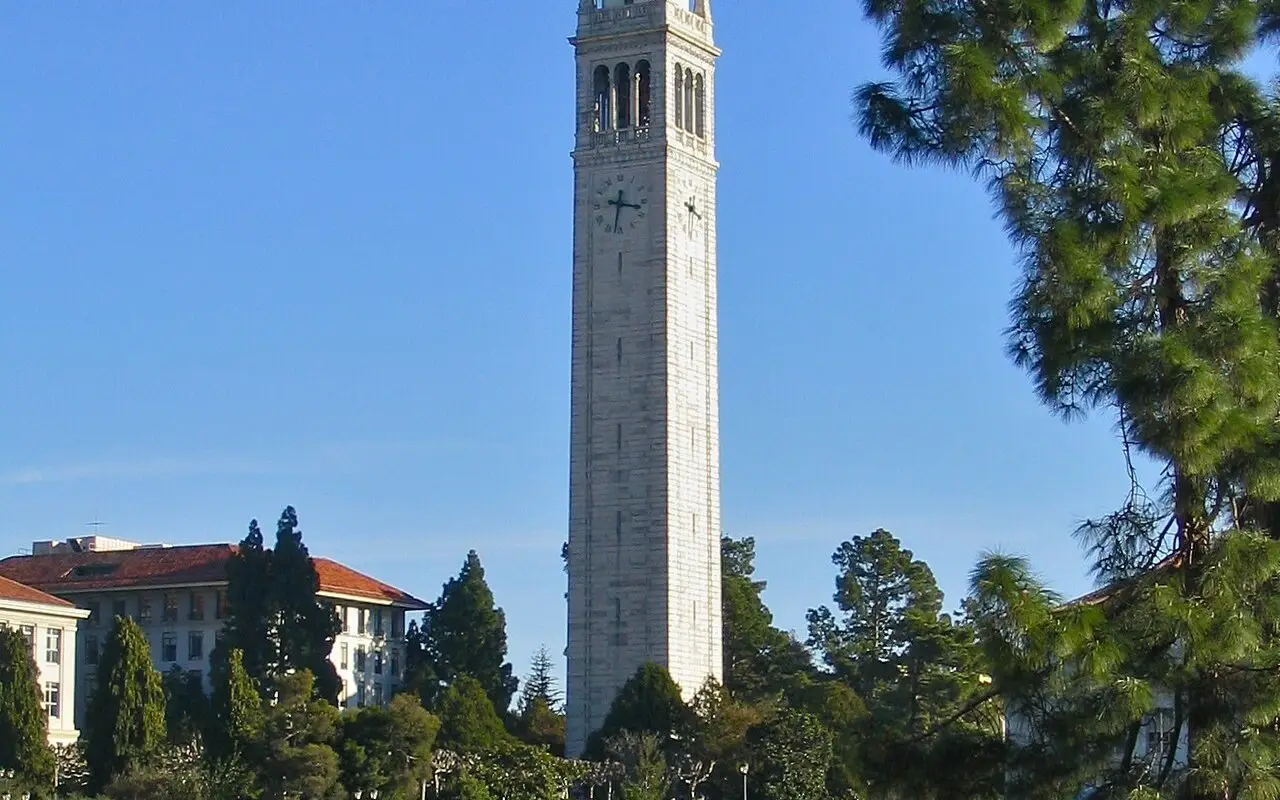
For its first decades the campus was plain. In the 1890s an international architectural competition sought to remake it as a city of learning, with Phoebe Apperson Hearst as the main donor, and her name stayed on the Hearst Mining Building and the Hearst Gymnasium1. John Galen Howard did not win the competition but carried out the plan, raising more than 20 key buildings, among them Doe Library, which opened in 1911, the Hearst Greek Theatre and Wheeler Hall. Gifts from Jane K. Sather paid for Sather Gate and the Campanile, finished in 1915, and California Memorial Stadium, completed in 1923, sits above the Hayward Fault, a fact fans see in a jagged line on the turf1.
A 2025 Stanford Daily comparison of the two campuses4 places Berkeley in the Beaux Arts tradition, with grand buildings in concrete and granite tones, against Stanford's warmer mix of Mission Revival and Romanesque. It gives Sather Tower a height of 307 feet, 22 feet more than Stanford's Hoover Tower, and calls it the second tallest freestanding clock and bell tower in the world. Sather Gate once marked the campus entrance, before the grounds reached Bancroft Way, and students have gathered and protested beneath it for decades4.
| Berkeley | Stanford | |
|---|---|---|
| Main style | Beaux Arts | Mission Revival and Romanesque |
| Main tower | Sather Tower, 307 feet | Hoover Tower, 285 feet |
| Materials and tones | Concrete and granite hues | Sandstone and warm tones |
| Signature landmarks | Doe Library, Sather Gate | Memorial Church, Main Quad |
Its research today
Science grew alongside the buildings. The brothers Joseph and John Le Conte were among the founding faculty and between them taught all the biological and physical sciences; later departments of zoology, botany, physiology, anatomy, paleontology and genetics were folded in 1989 into a new Department of Integrative Biology, as a 2018 newsletter of that department5 recounts, and seven of its members belong to the National Academy of Sciences5. In 1939 Ernest Lawrence won a Nobel Prize for the cyclotron, the first for any public university, and the faculty have since earned 21 more1. Glenn Seaborg's 1942 discovery of plutonium was one of 16 elements, including berkelium and californium, added by Berkeley and Lawrence Berkeley Lab scientists, and in 2012 Jennifer Doudna coinvented the CRISPR Cas9 tool for editing genes1.
“You look for new things, you look at new things”Charles Townes, physicist, quoted in a Berkeley retrospective, University of California, Berkeley
Biology still accounts for much of that work. The College of Letters and Science describes its Division of Biological Sciences6 as having more than 100 full time faculty in three departments, Molecular and Cell Biology, Integrative Biology and Neuroscience, and lists telomeres and telomerase, the early human relative known as Ardi and the molecular behavior of insulin among discoveries made there. The neuroscience that runs through this encyclopedia, from the hearing pathway to inhibitory neurons, belongs to the same broad field, and another sort of training, the clinical apprenticeship of surgical residency, is described separately.
Sources cited
- 150 years of light. University of California, Berkeley.
- How Berkeley Became Berkeley: The Origin Story of the University of California. University of California, Berkeley.
- The History of Women at UC Berkeley | Center for Studies in Higher Education. University of California, Berkeley.
- Stanford and Cal architecture: Who built it best?. The Stanford Daily, 2025.
- Insight SP18 150 Years of Discovery. University of California, Berkeley, 2018.
- Research in Biological Sciences. University of California, Berkeley, 2025.
Nearby entries
- 01
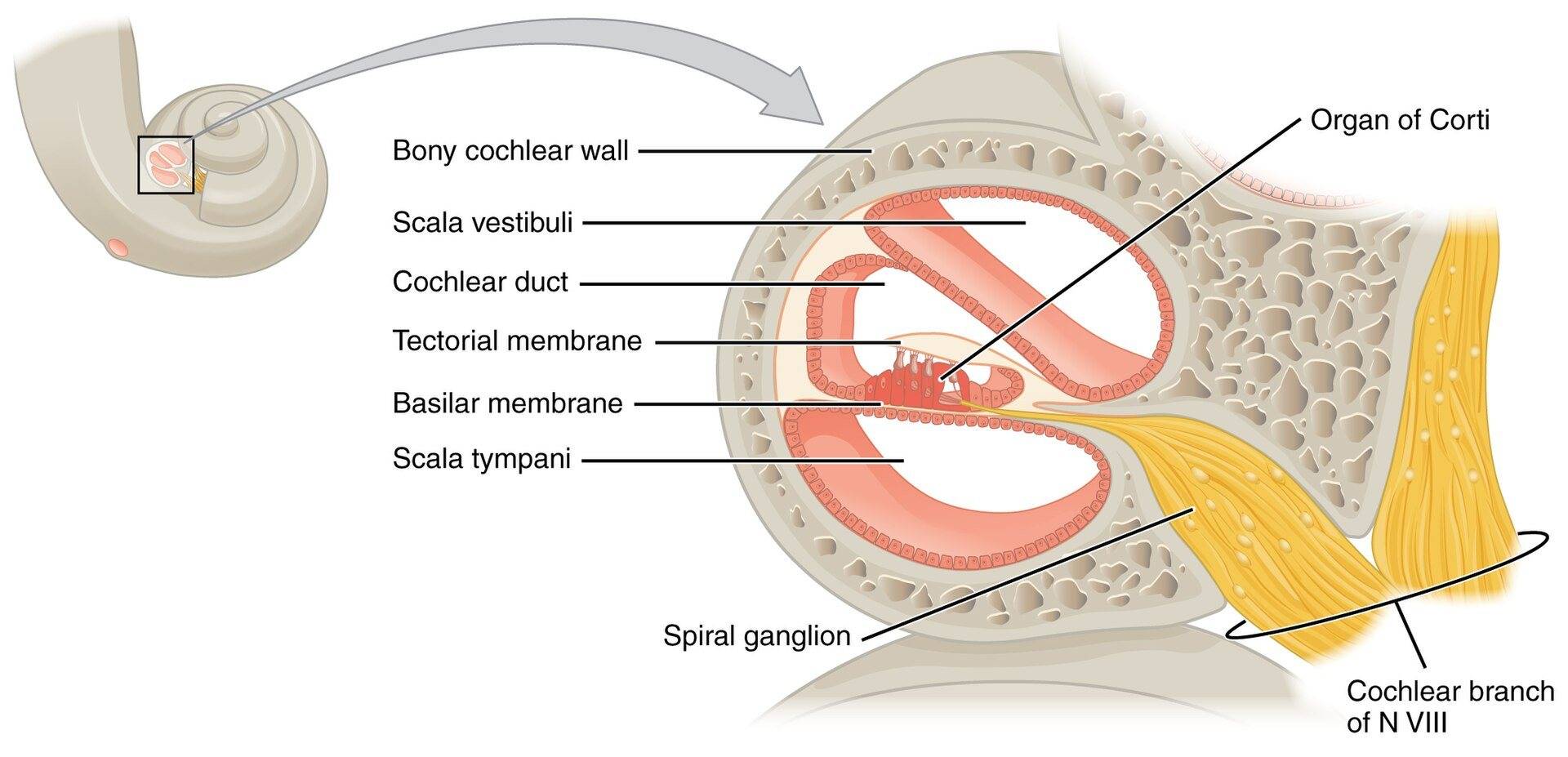
The Hearing Pathway
The chain of relays that carries a sound from the eardrum up to the cortex, and what is still unknown.
- 02
Surgical Residency
Long weeks on the wards, a national cap on duty hours, and the focused year that often follows.
- 03
Inhibitory Neurons
The brain's brake cells, their work in hearing, and a recent finding that the brake can push.


